
Paycheck to Paycheck: Breaking the Cycle Without a Big Raise

Photo credit: Savy Bargains
In this article
Living paycheck to paycheck isn't just about income. Explore the habits and small shifts that help people build breathing room in their finances.
Key Takeaways
- Living paycheck to paycheck is often driven by spending patterns, not just income level.
- A written record of every expense, however small, is the foundation of any workable budget.
- A small, dedicated emergency fund changes how financial setbacks affect your month.
- Automating savings, even a modest amount, removes the decision from every pay period.
- Reducing one or two fixed recurring costs can free more room than cutting daily spending alone.
Why income alone does not explain the paycheck-to-paycheck pattern
A significant share of American households report spending most or all of their monthly income before the next paycheck arrives, and this happens at many income levels, not only low ones. The pattern often has less to do with how much someone earns and more to do with how expenses are structured relative to income, and whether any system exists to create a gap between money coming in and money going out.
Spending drift is one common factor. Recurring costs accumulate gradually: a streaming service here, a gym membership there, a subscription box renewed automatically. Each individual cost seems minor, but the total compounds without notice. Without a regular review, monthly obligations grow until there is nothing left between paychecks.
Another factor is the absence of any financial buffer. When no emergency fund exists, every unexpected expense, a car repair, a medical copay, a home fix, goes directly onto a credit card or pulls from rent money. The following month starts in deficit, and the cycle deepens.
This article is general financial education and is not personalized financial advice. For decisions specific to your situation, consult a licensed financial professional.
What these steps are designed to do
The steps below are ordered to build stability in layers. Tracking comes first because no budget decision is reliable without accurate information. A buffer comes before aggressive debt payoff because a buffer prevents new debt. Automation comes before willpower-based saving because systems outlast motivation.
None of these steps require a raise or a windfall. They require time, honesty about current spending, and consistency over several months. For readers who also need to establish or repair a credit history alongside these steps, building credit from scratch covers that process in parallel.
What you will need
Bank or credit union statements
Used to identify where money is actually going each month, rather than where you think it goes.
Spreadsheet or free budgeting app
Used to organize income and expenses into categories so patterns become visible.
Separate savings account
Used to hold an emergency fund apart from everyday spending money.
Track every dollar for one full month
Pull two to three months of bank and credit card statements. Write down or enter every transaction into categories: housing, food, transportation, subscriptions, personal spending, debt payments, and miscellaneous. Do not estimate. The goal is an honest picture of current behavior, not an ideal one.
Most people find at least one or two categories where spending is significantly higher than expected. That gap between assumption and reality is where the cycle typically starts.
Calculate your actual monthly income
Use your take-home pay, the amount deposited after taxes and deductions, not your gross salary. If income varies month to month, average the last three months and use the lower end of that range as your planning number. Planning around a best-case income figure is one of the most common reasons budgets fail in practice.
Separate fixed costs from variable spending
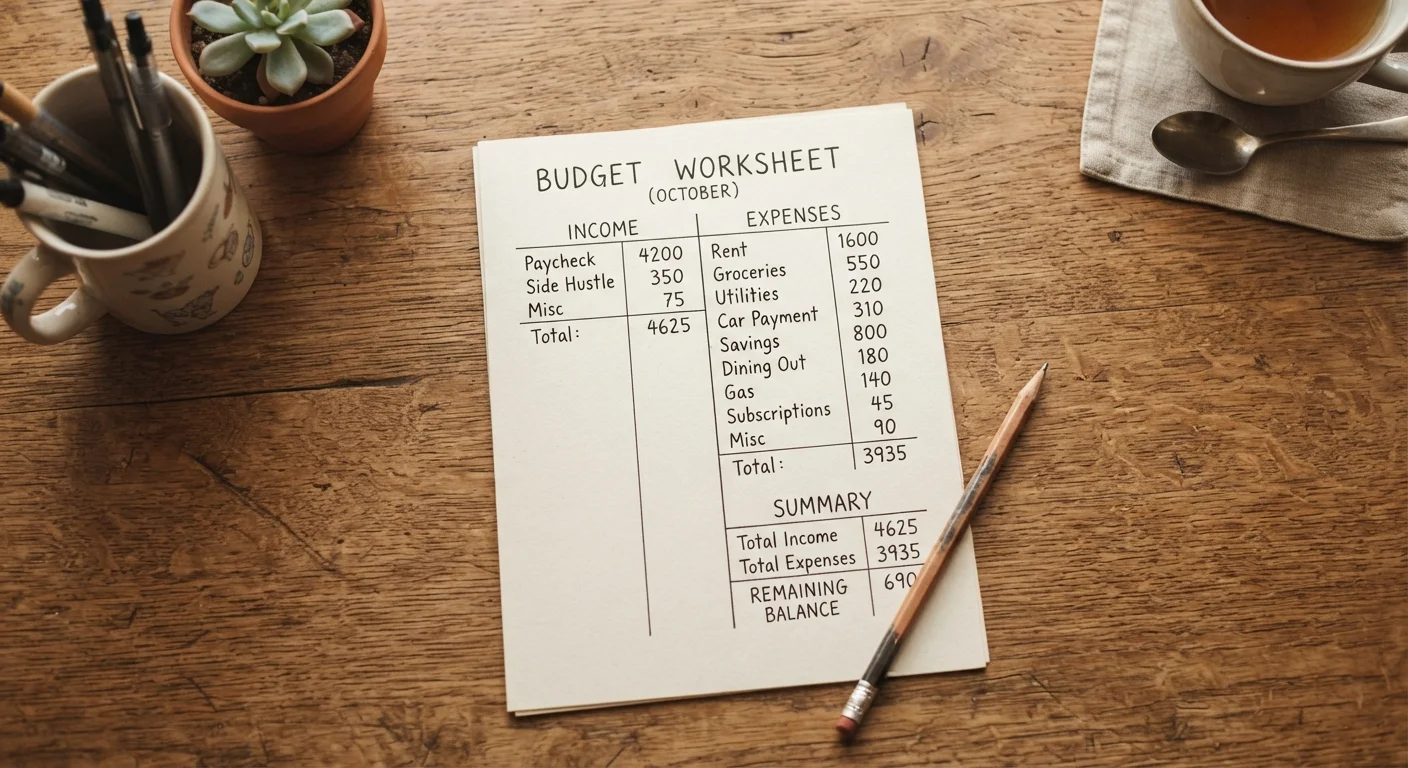
Fixed costs are amounts that stay the same each month: rent or mortgage, car payment, insurance premiums, and loan minimums. Variable costs change: groceries, gas, dining out, entertainment. List both columns separately.
This separation matters because your strategy for each is different. Fixed costs require negotiation or a structural change. Variable costs can be adjusted without any external party involved.
Build a bare-bones budget baseline
Using your actual income and the two cost columns, write out a budget where fixed costs and essential variable costs (food, transportation, utilities, minimum debt payments) are covered first. Whatever remains after those categories is your discretionary balance.
If that number is zero or negative, the focus shifts to either reducing a fixed cost or finding a way to increase income on the side. If there is a positive remainder, even a small one, move to the next step.
Start an emergency fund before paying down debt aggressively
A common mistake is directing every spare dollar toward debt while keeping no cash buffer. When an unexpected expense appears, the result is more debt. A small emergency fund, even $500 to $1,000, acts as a buffer that keeps a single setback from erasing weeks of progress.
Open a separate savings account if possible, and move a fixed amount there each pay period automatically. Even $25 per paycheck builds that buffer within a few months.
Automate savings before discretionary spending hits
Set up an automatic transfer to savings on the same day your paycheck arrives. When savings happen after spending, they rarely happen consistently. When they happen first, spending adjusts around the reduced balance. This is sometimes called paying yourself first, and it works precisely because it removes the need for a decision every pay period.
For broader financial habits that reinforce this approach, see our guide to habits that keep a budget on track.
Review and reduce at least one recurring fixed cost
Once a basic buffer is in place, focus on structural costs. Call your insurance provider to ask about available discounts or adjusted coverage levels. Review your phone plan. Check whether any annual subscriptions auto-renewed without review. Reducing a fixed cost by even $30 to $50 per month adds up to $360 to $600 per year without changing daily behavior.
For costs tied to your home, routine upkeep can prevent larger bills later. The seasonal home maintenance guide outlines which tasks protect against expensive repairs down the road.
After the basics are in place
Once a small emergency fund exists and the budget runs without a monthly deficit, the next priorities are growing that fund toward three months of essential expenses, then paying down high-interest debt systematically. Progress at this stage is measurable: the fund grows, the debt balance shrinks, and the distance between each paycheck and the edge of crisis widens.
If reducing costs has been a priority, looking at ways to stretch spending in other areas of life can help. The guide to traveling on a fixed income covers how to manage discretionary spending on travel without undoing budget progress. For general household and lifestyle costs, the Home and Lifestyle hub has additional resources on managing everyday expenses.
This article is for general informational and educational purposes only. It does not constitute personalized financial, tax, or legal advice. Individual circumstances vary. Consult a qualified financial professional before making decisions about your finances.

Author
Finance Editorial Team
Finance Editorial Team is the collective byline for our editorial team and contributor network. Articles published under this byline or an editorial pen name are researched, written, and reviewed according to our editorial standards for clarity, consistency, and independence before publication.
View all articles →