
Getting the Most From a High-Yield Savings Account

Photo credit: Savy Bargains
In this article
High-yield savings accounts offer better returns than standard accounts, but there are trapb-offs. Learn what to consider before moving your money.
Key Takeaways
- High-yield savings accounts typically pay significantly more interest than traditional savings accounts.
- These accounts are FDIC-insured up to $250,000 per depositor, per institution, at qualifying banks.
- Interest rates on these accounts are variable and can drop without notice.
- Some accounts have minimum balance requirements or limit how often you can withdraw funds.
- They work best for emergency funds or short-term savings goals, not long-term wealth building.
- Consulting a licensed financial adviser can help you decide how a high-yield account fits your broader financial picture.
Higher interest rate than standard savings accounts
High-yield savings accounts have historically paid annual percentage yields (APYs) many times higher than the national average for traditional savings accounts. Even a seemingly small rate difference adds up on balances held over months or years.
FDIC or NCUA insurance protects your deposit
Accounts held at FDIC-insured banks or NCUA-insured credit unions are covered up to $250,000 per depositor, per institution. That federal protection makes these accounts low-risk compared to investment options.
Funds remain accessible when you need them
Unlike certificates of deposit (CDs), high-yield savings accounts generally allow withdrawals without a penalty. This makes them practical for emergency reserves where access on short notice matters.
Low barrier to open and maintain
Many online banks and credit unions offer high-yield savings accounts with no monthly maintenance fees and low or no minimum opening deposits, making them accessible to a wide range of savers.
Interest rates are variable and can fall
The APY on a high-yield savings account is not locked in. Banks adjust rates in response to Federal Reserve policy changes, and a rate that looks attractive today may drop within weeks or months.
Returns may not keep pace with inflation
Even a competitive savings rate can fall below the rate of inflation, meaning the purchasing power of your money may shrink in real terms over time. This is worth weighing for money held long-term.
Some accounts limit monthly withdrawals
Certain institutions impose transaction limits per statement cycle. Exceeding those limits can trigger fees or a conversion of the account to a different product type.
Interest income is taxable
The IRS treats interest earned in a savings account as ordinary income. Savers in higher tax brackets will see a portion of their yield offset by the federal and state income tax owed on it.
Not designed for long-term wealth growth
Compared to tax-advantaged retirement vehicles like IRAs or 401(k)s, a savings account offers no tax deferral on growth. For long-term goals, a retirement account may be more appropriate.
What a high-yield savings account actually is
A high-yield savings account is a deposit account that pays a higher annual percentage yield (APY) than a conventional savings account. The core mechanics are the same: you deposit money, the bank holds it, and the bank pays you interest. The difference is the rate. Online banks, in particular, tend to offer more competitive yields because they carry lower overhead costs than traditional brick-and-mortar institutions.
These accounts are federally insured, either through the Federal Deposit Insurance Corporation (FDIC) at banks or the National Credit Union Administration (NCUA) at credit unions, up to $250,000 per depositor per institution. That insurance is what separates them from higher-risk ways to grow money. If you are also thinking about accounts designed for medical or educational expenses, the guide to HSAs, FSAs, and 529 plans covers how those differ in structure and tax treatment.
The advantages worth knowing
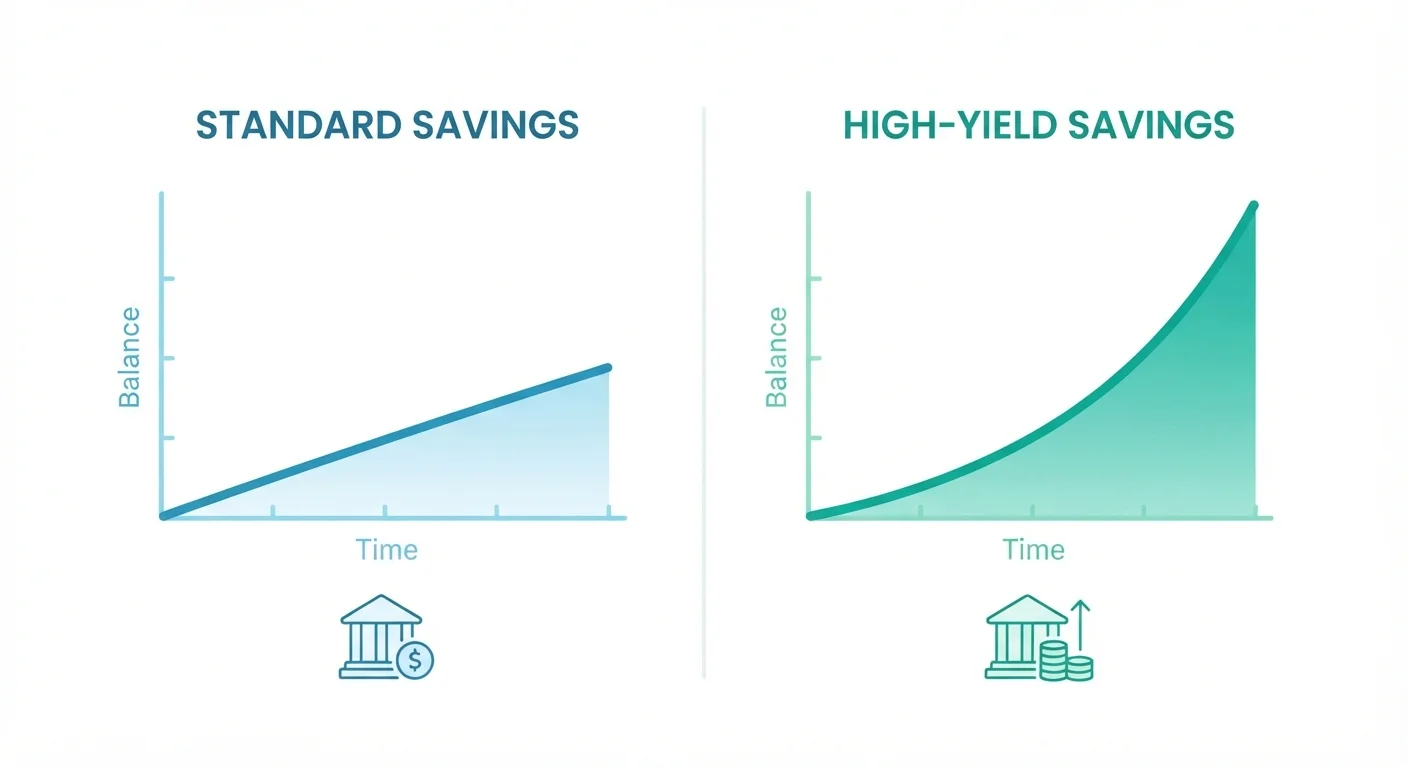
The most straightforward benefit is earning more interest on money that would otherwise sit idle. The gap between a standard savings rate and a high-yield rate can be significant, and that difference compounds over time, particularly on larger balances.
Higher interest rate than standard savings accounts
High-yield savings accounts have historically paid annual percentage yields (APYs) many times higher than the national average for traditional savings accounts. Even a seemingly small rate difference adds up on balances held over months or years.
FDIC or NCUA insurance protects your deposit
Accounts held at FDIC-insured banks or NCUA-insured credit unions are covered up to $250,000 per depositor, per institution. That federal protection makes these accounts low-risk compared to investment options.
Funds remain accessible when you need them
Unlike certificates of deposit (CDs), high-yield savings accounts generally allow withdrawals without a penalty. This makes them practical for emergency reserves where access on short notice matters.
Low barrier to open and maintain
Many online banks and credit unions offer high-yield savings accounts with no monthly maintenance fees and low or no minimum opening deposits, making them accessible to a wide range of savers.
For savers who have struggled to build a cushion, having a dedicated account with a meaningful return can reinforce the habit of setting money aside. The barriers that make saving difficult are often behavioral, and a visible return can help sustain motivation.
The limitations to consider
The most significant drawback is that the rate is not guaranteed. A bank can lower its APY at any time, and in periods when the Federal Reserve cuts its benchmark rate, high-yield savings rates across the market often follow. A rate that seems attractive at account opening may look different six months later.
Interest rates are variable and can fall
The APY on a high-yield savings account is not locked in. Banks adjust rates in response to Federal Reserve policy changes, and a rate that looks attractive today may drop within weeks or months.
Returns may not keep pace with inflation
Even a competitive savings rate can fall below the rate of inflation, meaning the purchasing power of your money may shrink in real terms over time. This is worth weighing for money held long-term.
Some accounts limit monthly withdrawals
Certain institutions impose transaction limits per statement cycle. Exceeding those limits can trigger fees or a conversion of the account to a different product type.
Interest income is taxable
The IRS treats interest earned in a savings account as ordinary income. Savers in higher tax brackets will see a portion of their yield offset by the federal and state income tax owed on it.
Not designed for long-term wealth growth
Compared to tax-advantaged retirement vehicles like IRAs or 401(k)s, a savings account offers no tax deferral on growth. For long-term goals, a retirement account may be more appropriate.
Variable rates: what to watch for
When you open a high-yield savings account, the advertised APY applies at account opening but is subject to change. Checking your account's rate periodically and comparing it to current market rates is a practical habit. No action is required just because a rate changes, but awareness helps you make informed decisions about where your cash sits.
Tax treatment is another factor some savers overlook. Interest earned is reported to the IRS as ordinary income, so the after-tax yield will be lower than the stated APY for anyone in a taxable income bracket. This does not eliminate the account's value, but it is part of an honest calculation.
Where this account fits in a broader financial plan
A high-yield savings account works well as a home for an emergency fund, typically three to six months of essential expenses held in liquid form. It also suits short-term savings goals: a planned home repair, a travel fund, or a vehicle purchase within the next year or two. For ideas on managing money across those kinds of goals, the habits that keep a budget on track covers practical approaches to consistent financial management.
For long-term goals, the account's variable, taxable returns make it a less efficient vehicle than tax-advantaged retirement accounts. Deciding where each dollar belongs across different account types is a question worth discussing with a licensed financial adviser who can assess your specific situation. This article is general financial education and is not personalized financial advice.

Author
Finance Editorial Team
Finance Editorial Team is the collective byline for our editorial team and contributor network. Articles published under this byline or an editorial pen name are researched, written, and reviewed according to our editorial standards for clarity, consistency, and independence before publication.
View all articles →