
Debt Snowball vs. Debt Avalanche: Two Paths Out of Debt
Photo credit: Savy Bargains
In this article
The snowball and avalanche methods are both popular debt payoff strategies. See how they differ so you can choose the approach that fits your habits.
Key Takeaways
- The debt snowball method targets the smallest balances first, regardless of interest rate.
- The debt avalanche method targets the highest-interest debt first to reduce total interest paid.
- Neither method requires extra income; both rely on redirecting payments as each debt is cleared.
- The avalanche typically costs less in interest over time, but the snowball can improve follow-through.
- Choosing the method you will actually stick with matters more than which one looks better on paper.
How each method works
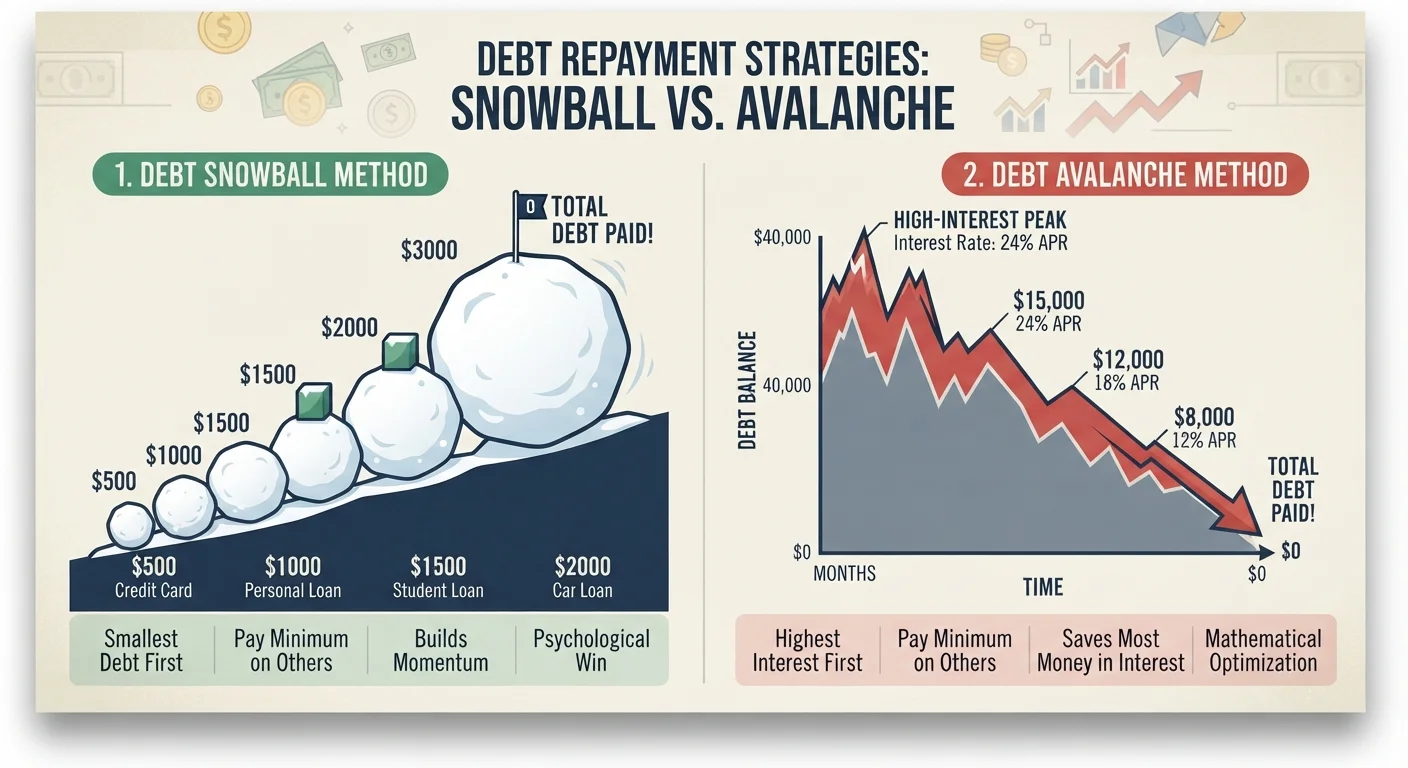
Both strategies share the same basic mechanic. You make minimum payments on every debt you owe, then direct any extra money toward one specific debt. When that debt is gone, you roll the freed-up payment into the next target. The difference is how you rank your debts.
With the debt snowball, you list debts from the smallest balance to the largest. You pay them off in that order. The dollar amount you owe is the only factor; the interest rate does not affect the sequence.
With the debt avalanche, you list debts from the highest annual percentage rate (APR) to the lowest. You pay them off in that order. The balance size does not affect the sequence.
In both cases, each cleared debt frees up money that rolls forward to the next one, so your payment toward the active target grows over time.
The cost difference in practice
Because high-interest debt compounds faster, paying it first generally reduces the total amount you spend to become debt-free. The avalanche method captures that saving directly.
The snowball method can cost more in total interest, sometimes by a meaningful amount, if your highest-rate debts also carry large balances. However, when small-balance debts happen to carry the highest rates, the two methods can produce similar results or even identical ones.
The gap between methods narrows when debts are few in number, when balances are close in size, or when interest rates do not vary much across accounts. The gap widens when you carry a mix of very small, low-rate debts alongside large, high-rate ones.
| Criterion | Debt Snowball | Debt Avalanche |
|---|---|---|
| Payoff order | Smallest balance first | Highest APR first |
| Total interest paid | Potentially higher | Generally lower |
| Early motivation | Strong (quick wins) | Slower to materialize |
| Math complexity | Simple | Slightly more tracking |
| Best condition | Many small balances | High-rate, large balances |
| Accounts closed fastest | Yes, by design | Not necessarily |
The psychology of each approach
Personal finance research has found that behavior, not math, is often the reason people fall off repayment plans. The debt snowball was designed around this reality. Paying off a full account, even a small one, can reinforce the habit of making extra payments.
The avalanche asks you to keep paying toward a large, high-rate debt that may not disappear for a long time. That can feel discouraging when progress is hard to see. Some people find the lack of early milestones makes it harder to stay consistent.
Neither response is a character flaw. Recognizing which pattern fits your habits is part of choosing the right method. A plan you follow for two years will generally do more for your finances than a theoretically optimal plan you abandon in three months.
When neither method fits perfectly
If your income is irregular or your budget is very tight, even minimum payments can be difficult to maintain consistently. In those situations, a credit counselor or nonprofit debt management program may offer tools beyond what either method provides on its own. The Consumer Financial Protection Bureau (CFPB) offers a free online resource to help people find accredited nonprofit counselors.
Choosing a starting point
Before selecting a method, gather the current balance, minimum payment, and APR for each debt. List them both ways: once sorted by balance (snowball order) and once sorted by rate (avalanche order). Compare the two lists.
If the first debt on the snowball list is something you could realistically eliminate within a few months, that early win may be worth the potential extra interest cost. If the first debt on the avalanche list is also relatively small, the two methods may converge quickly anyway.
Some people combine elements by starting with the snowball to build confidence, then switching to the avalanche once they have a strong repayment habit in place. Either approach is valid as long as the minimum payments on all other debts remain current.
This article is for general informational and educational purposes only and does not constitute personalized financial, tax, or legal advice. Consult a licensed financial professional for guidance specific to your situation.

Author
Finance Editorial Team
Finance Editorial Team is the collective byline for our editorial team and contributor network. Articles published under this byline or an editorial pen name are researched, written, and reviewed according to our editorial standards for clarity, consistency, and independence before publication.
View all articles →