
Domestic vs. International Travel Insurance: How Coverage Differs

Photo credit: Savy Bargains
In this article
The coverage you need for a weekend road trip differs significantly from an overseas trip. See how these two policy types compare.
Key Takeaways
- Domestic travel insurance focuses on trip cancellation and interruption, since U.S. health coverage usually applies at home.
- International policies add emergency medical, evacuation, and repatriation benefits that most domestic health plans do not cover abroad.
- Pre-existing condition waivers matter more for international travel, where out-of-pocket medical costs can be severe.
- Neither policy type guarantees coverage for every situation; reading the actual policy document is necessary before you buy.
- Seniors and travelers with health conditions face higher exposure abroad and should review coverage limits carefully.
What each type of policy is designed to do
Travel insurance is a broad category. A policy purchased for a three-day cruise to the Bahamas and one bought for a weekend drive to a national park may share a name, but their structures differ in meaningful ways. Understanding that difference starts with knowing what risks each policy is built to address.
Domestic travel insurance covers trips within the United States. Because American travelers generally have health coverage that applies inside the country, the medical component of these policies is less central. The focus is on financial losses: prepaid hotel rooms, nonrefundable flights, and event tickets that go unused if a trip is canceled or cut short. Baggage protection and travel delay benefits are also common.
International travel insurance is built around a different set of exposures. Once a traveler leaves the United States, most domestic health insurance plans either stop covering them entirely or pay only a small fraction of foreign medical costs. That gap is what international policies are primarily designed to fill, alongside the same trip cancellation and baggage protections a domestic policy provides. For a fuller overview of what travel insurance generally covers, see Travel Insurance 101.
Medical coverage: the biggest practical difference
For most American travelers, health insurance does not follow them overseas. Medicare, for example, generally does not pay for care received outside the United States, with limited exceptions. Many employer-sponsored and marketplace plans have similar restrictions. That makes emergency medical coverage one of the most consequential benefits in an international travel policy.
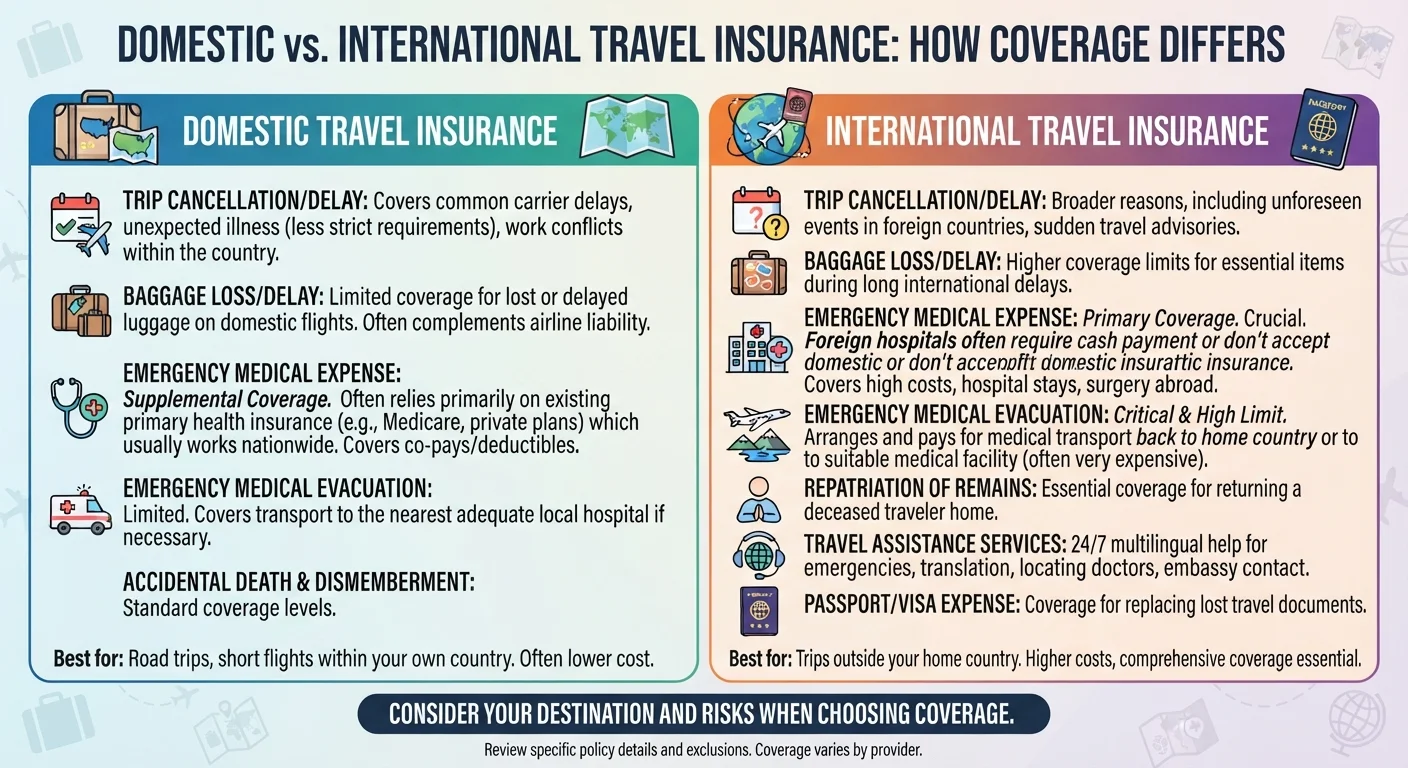
A typical international policy includes emergency medical coverage for hospitalization, physician visits, and urgent care abroad. It also covers emergency medical evacuation, which moves a patient to an adequate medical facility, and repatriation of remains if a traveler dies abroad. These benefits are not standard in domestic policies, because the need for them is far lower inside the United States.
The financial stakes are real. Medical evacuation from a remote international location can cost tens of thousands of dollars without insurance. The real cost of traveling without coverage explains where those expenses come from and how quickly they accumulate.
Seniors in particular face higher exposure. Because Medicare coverage abroad is so limited, an international policy with strong emergency medical limits is worth reviewing carefully before any overseas trip. Travelers with pre-existing conditions face additional planning steps around documentation and coverage waivers.
Trip cancellation, interruption, and delay
Both domestic and international policies typically include trip cancellation and trip interruption coverage. These benefits reimburse prepaid, nonrefundable costs if a covered reason, such as a serious illness or a death in the family, forces a traveler to cancel before departure or return home early.
The covered reasons in a policy matter as much as the benefit limit. A standard policy covers named perils; cancel for any reason (CFAR) coverage is a separate, optional upgrade available on some international plans that reimburses a percentage of trip costs regardless of the reason. CFAR is less common in domestic policies, though some insurers offer it.
Travel delay benefits work similarly in both policy types, paying for meals and lodging when a trip is disrupted by weather, mechanical failure, or other covered causes. The daily and per-trip limits vary by policy and are worth comparing when you shop.
| Coverage area | Domestic policy | International policy | |
|---|---|---|---|
| Emergency medical | Rarely included; relies on health plan | Core benefit; often required abroad | |
| Medical evacuation | Not standard | Typically included | |
| Trip cancellation | Standard benefit | Standard benefit | |
| Trip interruption | Standard benefit | Standard benefit | |
| Baggage loss or delay | Commonly included | Commonly included | |
| Pre-existing condition waiver | Less common; lower stakes | Available; time-sensitive window | |
| Cancel for any reason (CFAR) | Rarely available | Optional upgrade on some plans | |
| Repatriation of remains | Not standard | Typically included |
Pre-existing conditions and coverage waivers
Pre-existing medical conditions appear in both policy types, but the stakes are higher internationally. A domestic traveler who develops a flare of a chronic condition mid-trip may have their regular health plan to fall back on. A traveler abroad may not have that safety net.
Many international travel insurance policies exclude pre-existing conditions by default. A waiver, usually available when a policy is purchased within a short window after the initial trip deposit, can remove that exclusion. The window is typically 10 to 21 days, depending on the insurer, and the traveler must be medically able to travel at the time of purchase.
Domestic policies may also contain pre-existing condition language, but the practical impact is smaller when a traveler's regular health coverage remains active. That said, reading the exclusions in any policy before purchase is always necessary. Many travelers assume their credit card or existing health plan protects them more broadly than it does. Common myths about travel insurance covers several of those misunderstandings in detail.
This article is for general informational purposes only and does not constitute insurance, financial, or medical advice. Coverage terms, exclusions, and eligibility vary by insurer and policy. Readers should review actual policy documents and consult a licensed insurance professional before purchasing any travel insurance product.

Author
Travel Editorial Team
Travel Editorial Team is the collective byline for our editorial team and contributor network. Articles published under this byline or an editorial pen name are researched, written, and reviewed according to our editorial standards for clarity, consistency, and independence before publication.
View all articles →