
Travel Insurance 101: What It Covers and When You Actually Need It

Photo credit: Savy Bargains
In this article
Learn what travel insurance typically covers, what it doesn't, and how to decide if a policy makes sense for your next trip.
Key Takeaways
- Travel insurance reimburses prepaid trip costs and covers certain emergencies, but terms vary widely between policies.
- Standard domestic health plans often do not cover medical care abroad, making medical coverage a common reason travelers buy a policy.
- Pre-existing conditions, adventure activities, and pandemic-related cancellations are common exclusions that require careful review.
- The higher your non-refundable trip costs and the more complex your health situation, the stronger the case for a policy.
- Always read the actual policy document before purchasing; summaries can omit important exclusions.
What travel insurance is and how it works
Travel insurance is a type of short-term insurance that covers financial losses tied to a specific trip. You pay a premium before departure, and if a covered event occurs, including a cancellation, a medical emergency, or lost baggage, you file a claim and the insurer reimburses you up to the policy's stated limits.
Policies are sold as single-trip plans that cover one journey, or as annual multi-trip plans for people who travel frequently. Coverage levels vary widely, so two policies that both advertise "trip cancellation" may have very different lists of covered reasons and different dollar limits.
This article is general information
The coverage details described here reflect common policy structures. Actual terms, limits, and exclusions vary by insurer and by policy. For decisions about your own coverage, review the policy documents directly and consider consulting a licensed insurance agent.
The common myths about travel insurance that catch travelers off guard often stem from assuming that a credit card benefit or a domestic health plan provides the same protection as a dedicated travel policy. They generally do not.
Trip cancellation coverage
A benefit that reimburses prepaid, non-refundable trip costs if you cancel for a reason listed in the policy, such as a serious illness or a natural disaster affecting your destination.
Emergency medical evacuation
Coverage that pays to transport you to an appropriate medical facility, or back home, when local care is inadequate and the cost of transport would otherwise fall to you.
Pre-existing condition
A health condition that existed before you purchased the policy. Most standard policies exclude claims related to pre-existing conditions unless a specific waiver is added.
Cancel for any reason (CFAR)
An optional upgrade that lets you cancel a trip for reasons not listed in the base policy and receive a partial reimbursement, typically 50% to 75% of prepaid costs.
Primary vs. secondary coverage
Primary coverage pays claims directly without requiring you to first file with another insurer. Secondary coverage pays only after your other insurance has paid its share.
Exclusion
A situation, event, or condition that a policy explicitly does not cover. Exclusions are listed in the policy document and vary by insurer.
What a standard policy typically covers
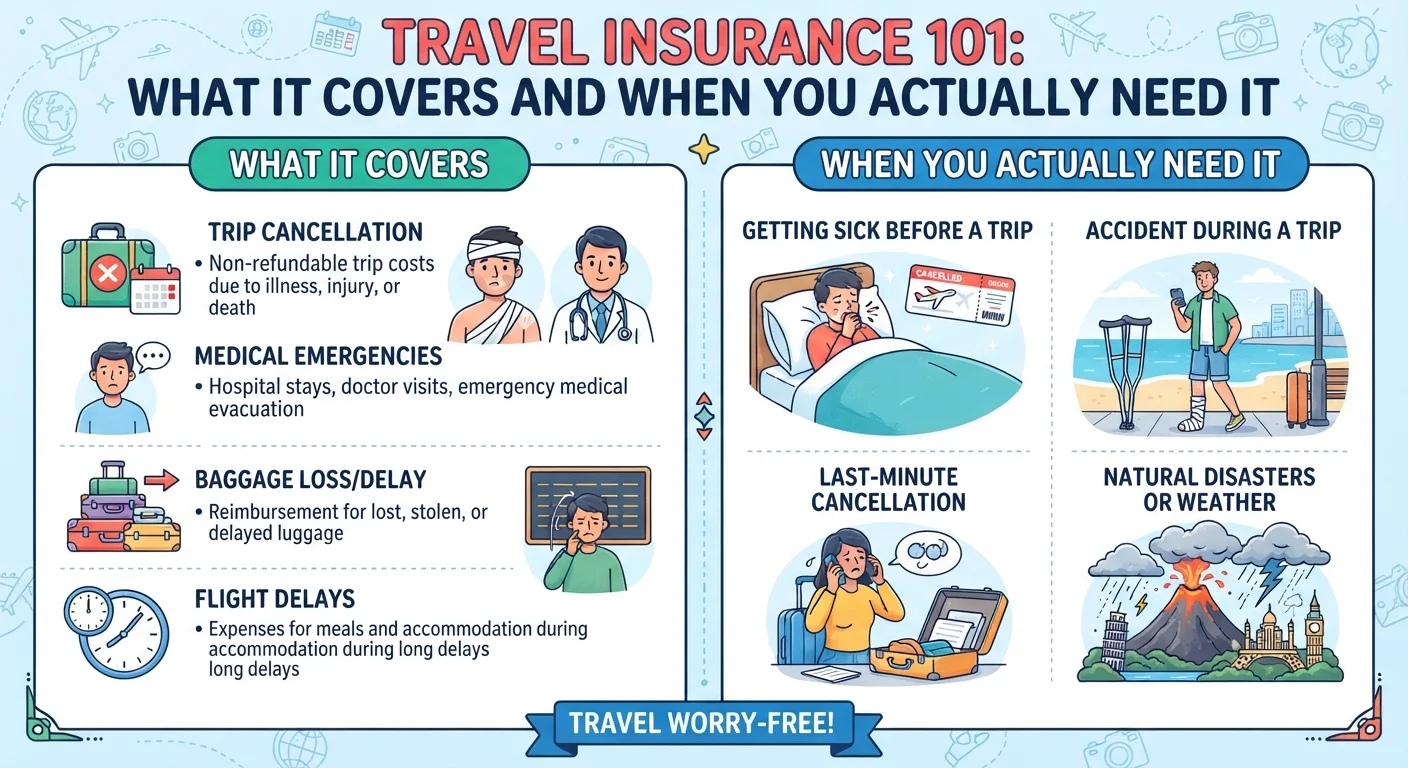
Most comprehensive travel insurance policies include some combination of the following benefits. Limits and conditions apply to each one.
- Trip cancellation: reimburses prepaid, non-refundable costs if you cancel before departure for a covered reason, such as a sudden illness, injury, or death of a traveling companion.
- Trip interruption: covers costs if your trip is cut short after departure for a covered reason, often at a higher reimbursement rate than cancellation.
- Emergency medical expenses: pays for treatment if you become ill or injured during travel. This is especially relevant for international trips, where your domestic health plan may not apply at all.
- Emergency medical evacuation: covers transport to a suitable hospital or back home when local facilities cannot provide adequate care. Evacuation costs can reach tens of thousands of dollars without coverage. See our article on the real cost of traveling without insurance for context on what these bills can look like.
- Baggage loss or delay: reimburses the value of lost or stolen bags, or covers essential purchases if bags are delayed.
- Travel delay: covers meals and accommodation if a covered delay keeps you from reaching your destination on schedule.
What travel insurance usually does not cover
Exclusions vary by policy, but several categories appear consistently across most standard plans.
- Pre-existing conditions: a condition diagnosed or treated before the policy purchase date is typically excluded unless you add a waiver (see the key concepts above).
- Adventure and high-risk activities: skydiving, backcountry skiing, scuba diving, and similar activities are often excluded or require a rider.
- Foreseeable events: if a hurricane is already named and heading toward your destination when you purchase the policy, the resulting cancellation is usually not covered.
- Pandemics and government travel bans: coverage for pandemic-related cancellations varies considerably. Some policies cover illness from a pandemic but not fear of travel or government-mandated closures. Read the policy language carefully.
- Alcohol- or drug-related incidents: most policies exclude claims arising from intoxication.
- Change of mind: canceling because you no longer want to travel is not covered under standard cancellation terms. CFAR upgrades exist specifically for this scenario.
Policy summaries can omit key details
Marketing summaries and comparison sites show headline benefits but rarely list every exclusion. Before purchasing, read the full policy document, specifically the exclusions and definitions sections. If a covered reason sounds broad, check whether the policy's definition of that term matches what you expect.
When a policy is worth considering
Travel insurance is not a necessity for every trip. A short domestic drive with fully refundable bookings and solid health coverage may not warrant the expense. The calculation changes when several factors combine.
Non-refundable trip costs are the clearest factor. If you have paid thousands of dollars in advance for flights, a cruise, or a package tour, cancellation coverage directly protects that investment. The difference between domestic and international coverage needs also affects whether a policy makes financial sense.
Medical coverage is a separate consideration. Medicare generally does not cover care outside the United States, and many private health plans have limited international networks or require you to pay upfront and seek reimbursement later. A travel policy with strong medical and evacuation benefits fills that gap for international trips.
Buy early to access more options
Purchasing a policy within 14 to 21 days of your first trip deposit typically unlocks optional add-ons like pre-existing condition waivers and cancel-for-any-reason upgrades. These windows are strict, and waiting until closer to departure usually means those options are no longer available.
Special considerations for senior travelers
Older travelers often have more at stake financially because trip costs tend to be higher, and health considerations are more likely to be relevant. Two areas deserve specific attention.
Age affects premiums. Travel insurance premiums increase with age, and travelers over 70 may see significantly higher rates, particularly for policies with high medical limits. Comparing policy structures, not just headline prices, helps clarify what you are actually getting for the cost.
Pre-existing conditions are more common in this group. If you take prescription medication or manage an ongoing health condition, a pre-existing condition waiver is worth understanding before you buy. Our article on planning a trip around a pre-existing condition covers documentation, waivers, and when to loop in a physician. For guidance on how insurance decisions fit into your broader health planning, the health insurance hub has additional context.
This article is for informational purposes only and does not constitute insurance, financial, or medical advice. Coverage terms, exclusions, and eligibility vary by insurer and by policy. Read your full policy document and consult a licensed insurance agent or a qualified healthcare professional for guidance specific to your situation.
Frequently Asked Questions

Author
Travel Editorial Team
Travel Editorial Team is the collective byline for our editorial team and contributor network. Articles published under this byline or an editorial pen name are researched, written, and reviewed according to our editorial standards for clarity, consistency, and independence before publication.
View all articles →