
Health Insurance Plan Types, Explained

Photo credit: Savy Bargains
In this article
HMO, PPO, EPO, HDHP: learn what each plan type means, how networks work, and which structure fits different coverage needs.
Key Takeaways
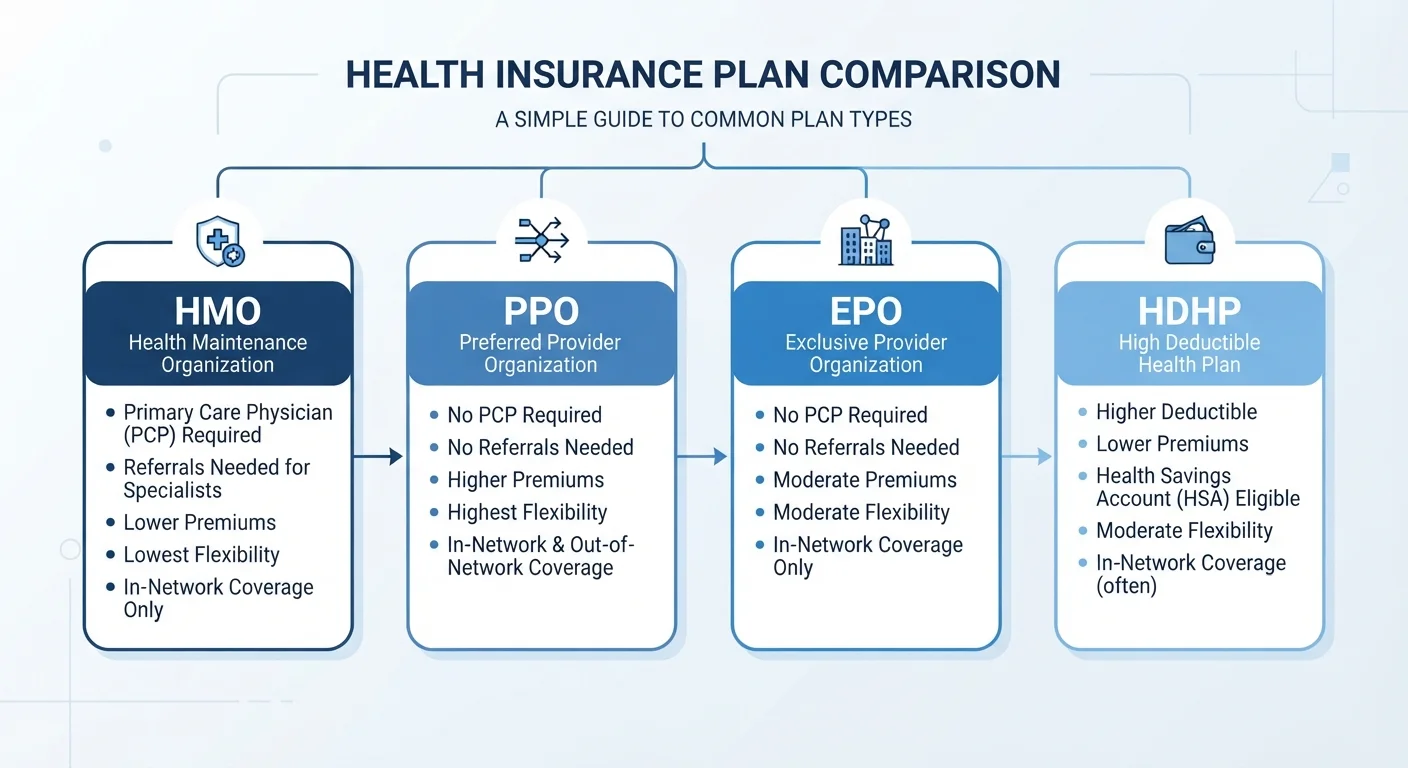
- HMOs require you to choose a primary care physician and get referrals for specialists, usually at lower premiums.
- PPOs let you see any provider in or out of network without a referral, but out-of-network care costs more.
- EPOs combine a PPO-style freedom from referrals with an HMO-style restriction to one network.
- HDHPs have higher deductibles and lower premiums, and they qualify you to open a Health Savings Account (HSA).
- Seniors have additional options through Medicare Advantage plans, which often mirror HMO or PPO structures.
- No plan type is universally better; the right fit depends on your health needs, budget, and preferred doctors.
The four main plan types and what they control
When you compare health insurance, the plan type tells you three things: which providers you can use, whether you need permission to see a specialist, and how costs change when you go outside the plan's network. The four types you will encounter most often are HMO, PPO, EPO, and HDHP.
Each type is a framework, not a specific policy. Two plans can both be PPOs and still differ in premium, deductible, and which hospitals they include.
HMO: lower cost, tighter network
An HMO (Health Maintenance Organization) requires you to select a primary care physician (PCP). Your PCP coordinates your care and provides referrals when you need to see a specialist. If you visit a specialist without a referral, or see a provider outside the HMO's network, the plan typically does not cover that visit.
HMOs generally have lower monthly premiums and predictable copays. The trapb-off is less flexibility. They work well for people who want straightforward, lower-cost coverage and whose preferred providers are in the network.
For a direct comparison of HMOs and PPOs, see HMO vs. PPO: Understanding the Core Difference.
PPO: more flexibility, higher cost
A PPO (Preferred Provider Organization) does not require a PCP or referrals. You can see any doctor, in or out of network, whenever you choose. In-network visits cost less; out-of-network visits cost more, but the plan still pays a portion.
PPOs carry higher premiums than HMOs. They suit people who see multiple specialists, travel frequently, or live in areas where their preferred providers are not concentrated in one network.
Check the provider directory first
Before enrolling in any plan, look up your current doctors and preferred hospitals in the plan's provider directory. Network participation changes annually, and a provider listed as in-network one year may not be the next. Verifying directly with both the insurer and the provider's office is the most reliable approach.
EPO: no referrals, but no out-of-network coverage
An EPO (Exclusive Provider Organization) removes the referral requirement but keeps a strict network boundary. You can self-refer to any specialist in the network without calling your primary doctor first. However, if you go outside the network for non-emergency care, the plan pays nothing.
EPOs often sit between HMOs and PPOs in price. They can work well for people who want the convenience of direct specialist access but do not need out-of-network flexibility.
HDHP: higher deductible, HSA eligibility
A High-Deductible Health Plan (HDHP) has a lower monthly premium paired with a higher deductible, which is the amount you pay before insurance coverage begins. The IRS sets minimum deductible thresholds that define whether a plan qualifies as an HDHP.
The significant benefit of an HDHP is access to a Health Savings Account (HSA). An HSA lets you set aside pre-tax dollars for qualified medical expenses, which can offset out-of-pocket costs. HDHPs can be any network structure (HMO, PPO, or EPO), so the HDHP label describes cost design, not network rules.
For a closer look at how these plans work financially, see What a High-Deductible Health Plan Actually Means for You.
Plan types for seniors: Medicare Advantage
Adults 65 and older enrolled in Medicare can choose Medicare Advantage (Part C), which is private insurance that covers Medicare benefits and often adds dental, vision, or drug coverage. Medicare Advantage plans use HMO or PPO network structures, so the same rules around referrals and out-of-network costs apply.
Original Medicare (Parts A and B) operates differently: it does not restrict you to a plan network in the way private HMOs or EPOs do, but it has its own gaps that supplemental coverage can address. For a broader overview, see Health Insurance for Seniors: Coverage Options Beyond Basic Medicare.
Medicare rules differ from private insurance
Original Medicare does not use the same closed-network model as private HMOs or EPOs. Most providers who accept Medicare assignment are available to all Medicare enrollees regardless of location. Medicare Advantage plans do use networks, so the plan type rules described in this article apply to those plans.
This article is for general informational purposes only and does not constitute medical, insurance, or financial advice. Coverage details, costs, and network rules vary by insurer, plan, and state. Consult a licensed insurance agent or benefits adviser before making coverage decisions. For personal health questions, speak with a qualified healthcare professional.
Frequently Asked Questions

Author
Health Editorial Team
Health Editorial Team is the collective byline for our editorial team and contributor network. Articles published under this byline or an editorial pen name are researched, written, and reviewed according to our editorial standards for clarity, consistency, and independence before publication.
View all articles →