
What a High-Deductible Health Plan Actually Means for You

Photo credit: Savy Bargains
In this article
Learn how HDHPs work, when they make financial sense, and how they pair with Health Savings Accounts to offset out-of-pocket costs.
Key Takeaways
- An HDHP has lower monthly premiums but requires you to pay more out of pocket before coverage kicks in.
- HDHPs are the only plan type that qualifies you to open a Health Savings Account (HSA).
- People who rarely use medical care often save money with an HDHP; those with chronic conditions may not.
- The IRS sets minimum deductible and out-of-pocket maximum thresholds that define a qualifying HDHP each year.
- Seniors on Medicare cannot contribute to an HSA, which limits one of the HDHP's main advantages.
Lower monthly premium than most plan types
Because you accept more upfront cost risk, insurers charge less each month. This can free up hundreds of dollars per year for people who stay relatively healthy.
Qualifies you to open a Health Savings Account
An HSA lets you set aside pre-tax money specifically for medical expenses. Unused funds roll over indefinitely and can be invested, making the account a secondary retirement savings tool.
Triple tax advantage through the paired HSA
HSA contributions are tax-deductible, growth is tax-free, and withdrawals for qualified medical expenses are also tax-free. No other common savings vehicle offers all three.
Preventive care is typically covered before the deductible
Federal rules require most HDHPs to cover a defined list of preventive services at no cost, so routine checkups and screenings do not count against your deductible.
Out-of-pocket maximum caps your total annual exposure
Once you reach the IRS-defined out-of-pocket maximum, the plan covers 100% of in-network costs for the rest of the year, giving you a ceiling on worst-case spending.
High upfront costs before insurance shares expenses
You pay the full negotiated cost of most services until you meet the deductible. For a family plan, that threshold can exceed several thousand dollars in a single year.
Can discourage necessary medical care
People aware of their high deductible sometimes delay or skip appointments to avoid out-of-pocket costs, which can let manageable conditions worsen.
HSA requires disciplined, consistent funding to work
The tax advantages only materialize if you actually contribute to the HSA. Without a funded account, the HDHP leaves you exposed with no savings buffer.
Not well-suited for chronic or ongoing conditions
People who regularly need specialist visits, prescriptions, or procedures will likely spend more under an HDHP than under a lower-deductible plan with higher premiums.
Seniors on Medicare cannot contribute to an HSA
Enrollment in Medicare Part A or Part B disqualifies you from making new HSA contributions, removing the primary financial incentive that makes HDHPs attractive.
Complexity in tracking deductible and network rules
You need to know which providers are in-network and how to read your Explanation of Benefits carefully to avoid unexpected bills. See our guide to reading an EOB for help.
What makes a health plan 'high-deductible'
A high-deductible health plan (HDHP) is a specific category of health insurance defined by the IRS, not just any plan with a large deductible. To qualify as an HDHP, a plan must meet minimum deductible thresholds and stay at or below annual out-of-pocket maximums set by the IRS each year. For 2025, an individual plan must have a deductible of at least $1,650, and a family plan at least $3,300.
The defining trapb-off is straightforward: you pay a lower monthly premium in exchange for covering more of your own medical costs until the deductible is met. After that, your insurer shares costs through coinsurance until you hit the out-of-pocket maximum, at which point the plan pays 100% of covered in-network services for the rest of the year.
For a broader look at how HDHPs compare to HMOs, PPOs, and EPOs, see our overview of health insurance plan types.
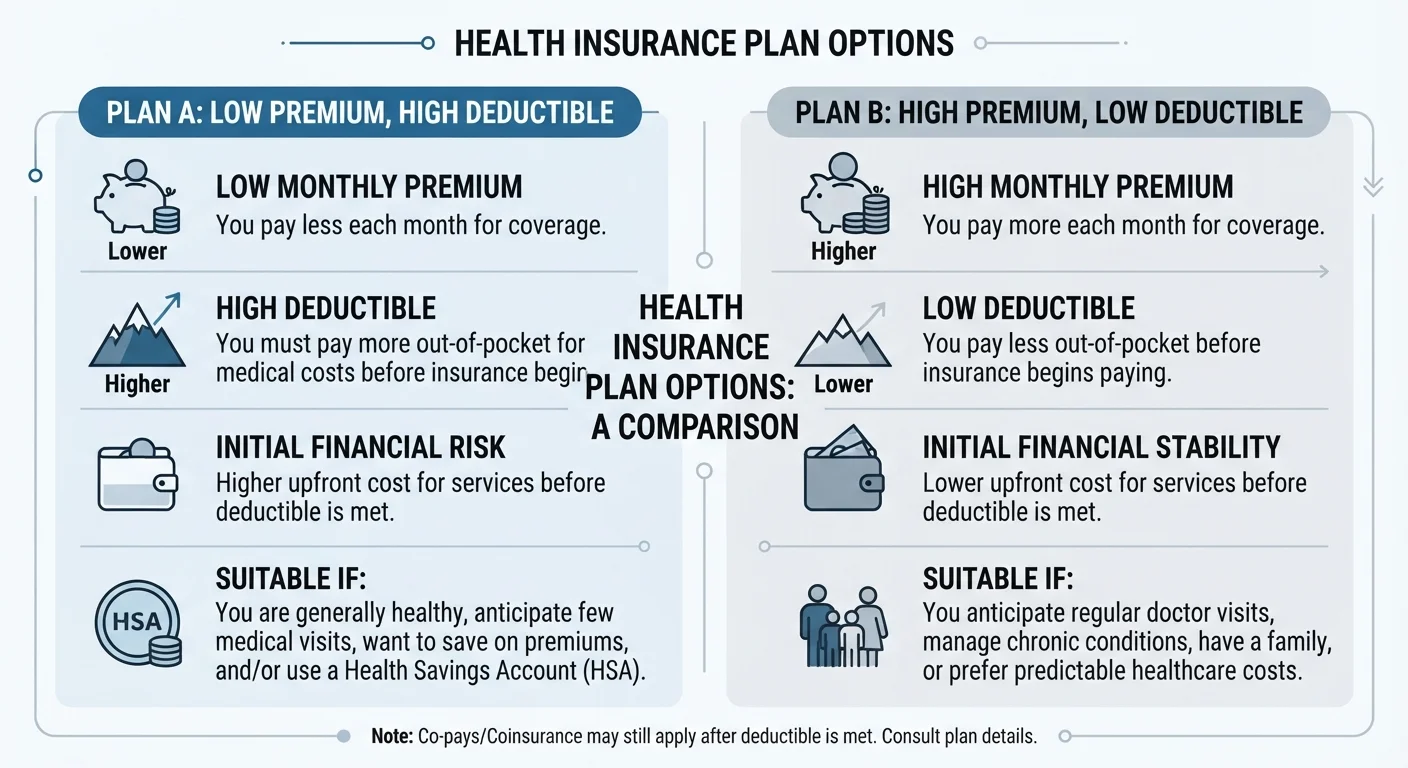
How the paired HSA changes the math
The feature that separates an HDHP from other high-cost plans is HSA eligibility. A Health Savings Account (HSA) is a tax-advantaged account you can only open if you are enrolled in a qualifying HDHP. Contributions reduce your taxable income, the money grows tax-free, and withdrawals for qualified medical expenses are never taxed.
Because unused funds roll over each year, an HSA can accumulate significant savings over time. Many account holders invest their HSA balance once it reaches a threshold, letting it grow similarly to a retirement account. After age 65, withdrawals for any purpose are taxed as ordinary income but carry no penalty, making the HSA function as a secondary retirement account.
For a deeper look at how HSAs compare with FSAs and 529 plans, see our guide to tax-advantaged accounts.
$1,650
IRS minimum deductible for individual HDHP coverage
The IRS sets this threshold annually; plans below it do not qualify as HDHPs for HSA-contribution purposes.
$8,300
IRS out-of-pocket maximum for individual HDHP coverage
This is the 2025 IRS cap; costs above this limit must be covered entirely by the plan for in-network care.
$4,300
Annual HSA contribution limit for individual coverage
The IRS sets HSA contribution ceilings each year; people 55 and older can contribute an additional $1,000 as a catch-up amount.
Weighing the advantages and disadvantages
An HDHP fits some situations well and others poorly. The advantages are most real when you are in good health, have savings to cover the deductible without hardship, and fund your HSA consistently each year.
Lower monthly premium than most plan types
Because you accept more upfront cost risk, insurers charge less each month. This can free up hundreds of dollars per year for people who stay relatively healthy.
Qualifies you to open a Health Savings Account
An HSA lets you set aside pre-tax money specifically for medical expenses. Unused funds roll over indefinitely and can be invested, making the account a secondary retirement savings tool.
Triple tax advantage through the paired HSA
HSA contributions are tax-deductible, growth is tax-free, and withdrawals for qualified medical expenses are also tax-free. No other common savings vehicle offers all three.
Preventive care is typically covered before the deductible
Federal rules require most HDHPs to cover a defined list of preventive services at no cost, so routine checkups and screenings do not count against your deductible.
Out-of-pocket maximum caps your total annual exposure
Once you reach the IRS-defined out-of-pocket maximum, the plan covers 100% of in-network costs for the rest of the year, giving you a ceiling on worst-case spending.
The disadvantages carry more weight if you have ongoing medical needs, a tight budget, or limited ability to build an HSA balance before you need it.
High upfront costs before insurance shares expenses
You pay the full negotiated cost of most services until you meet the deductible. For a family plan, that threshold can exceed several thousand dollars in a single year.
Can discourage necessary medical care
People aware of their high deductible sometimes delay or skip appointments to avoid out-of-pocket costs, which can let manageable conditions worsen.
HSA requires disciplined, consistent funding to work
The tax advantages only materialize if you actually contribute to the HSA. Without a funded account, the HDHP leaves you exposed with no savings buffer.
Not well-suited for chronic or ongoing conditions
People who regularly need specialist visits, prescriptions, or procedures will likely spend more under an HDHP than under a lower-deductible plan with higher premiums.
Seniors on Medicare cannot contribute to an HSA
Enrollment in Medicare Part A or Part B disqualifies you from making new HSA contributions, removing the primary financial incentive that makes HDHPs attractive.
Complexity in tracking deductible and network rules
You need to know which providers are in-network and how to read your Explanation of Benefits carefully to avoid unexpected bills. See our guide to reading an EOB for help.
Who should think carefully before choosing an HDHP
An HDHP is generally a poor fit for people who regularly use prescription drugs, see specialists, or manage a chronic condition such as diabetes or heart disease. In those situations, a lower-deductible plan with a higher premium often costs less in total over the year, even though the monthly bill looks larger.
Families with young children should model their expected annual costs carefully. Pediatric visits, illnesses, and the occasional urgent care trip can push a family toward its deductible quickly, erasing the premium savings.
Seniors approaching Medicare eligibility face a specific constraint. Once enrolled in Medicare Part A or Part B, you can no longer contribute to an HSA, which removes the tax benefit that makes HDHPs financially attractive. If you are nearing 65, compare the short-term premium savings against the years of potential HSA growth you would forgo.
HDHPs and Medicare eligibility
Once you enroll in any part of Medicare, you can no longer contribute to an HSA. If you plan to keep working past 65 and want to continue HSA contributions, you can delay Medicare enrollment, but this involves specific rules and deadlines. Consult a licensed benefits adviser or your State Health Insurance Assistance Program (SHIP) before making that decision.
For coverage options available to seniors beyond original Medicare, see our guide to senior health coverage options.
Making a realistic cost comparison
Before choosing an HDHP, run a sipb-by-side comparison against at least one lower-deductible alternative. Calculate total annual cost under each plan using two scenarios: a low-use year with only preventive care, and a moderate-use year where you hit roughly half the deductible.
Add the annual premium plus estimated out-of-pocket spending for each scenario. Then subtract the tax savings you would get from HSA contributions under the HDHP option. That comparison often reveals that the HDHP wins in low-use years and the lower-deductible plan wins when medical needs are significant.
For context on how PPOs and HMOs structure their cost sharing differently, see our comparison of HMO and PPO plans.
This article is for general informational purposes only and is not personalized medical, financial, or insurance advice. Plan details, IRS limits, and eligibility rules change annually. Consult a licensed insurance agent, a qualified financial adviser, or your HR benefits coordinator for guidance specific to your situation.

Author
Health Editorial Team
Health Editorial Team is the collective byline for our editorial team and contributor network. Articles published under this byline or an editorial pen name are researched, written, and reviewed according to our editorial standards for clarity, consistency, and independence before publication.
View all articles →