
Smart Habits That Keep a Budget on Track Over Time

Photo credit: Savy Bargains
In this article
Sticking to a budget long-term takes more than willpower. Explore the practical routines and mindset shifts that make consistent money management easier.
Key Takeaways
- Reviewing your budget regularly matters more than setting it up perfectly from the start.
- Automating savings and bill payments removes daily decision-making that leads to overspending.
- Tracking small, frequent purchases often reveals more spending room than cutting large expenses.
- Building a small buffer inside your budget prevents one unexpected cost from derailing the month.
- Linking spending categories to personal goals makes it easier to stay consistent without feeling restricted.
Why budgets fail after the first month
Most budgets fail not in the planning but in the follow-through. A budget built with careful numbers in January can be completely ignored by March, not because the numbers were wrong but because the habits supporting it were never established.
The core problem is treating a budget as a one-time setup rather than an ongoing practice. Income changes, expenses shift, and spending categories that seemed accurate in month one drift out of alignment. Without a routine for catching those drifts, the budget becomes a historical document rather than a working tool.
A second common failure is building a budget with no margin. When every dollar is assigned and one small unexpected expense appears, the whole structure collapses. That frustration can lead people to abandon the process entirely rather than make a small adjustment. Understanding why saving is hard in practice helps explain why structure matters as much as intention.
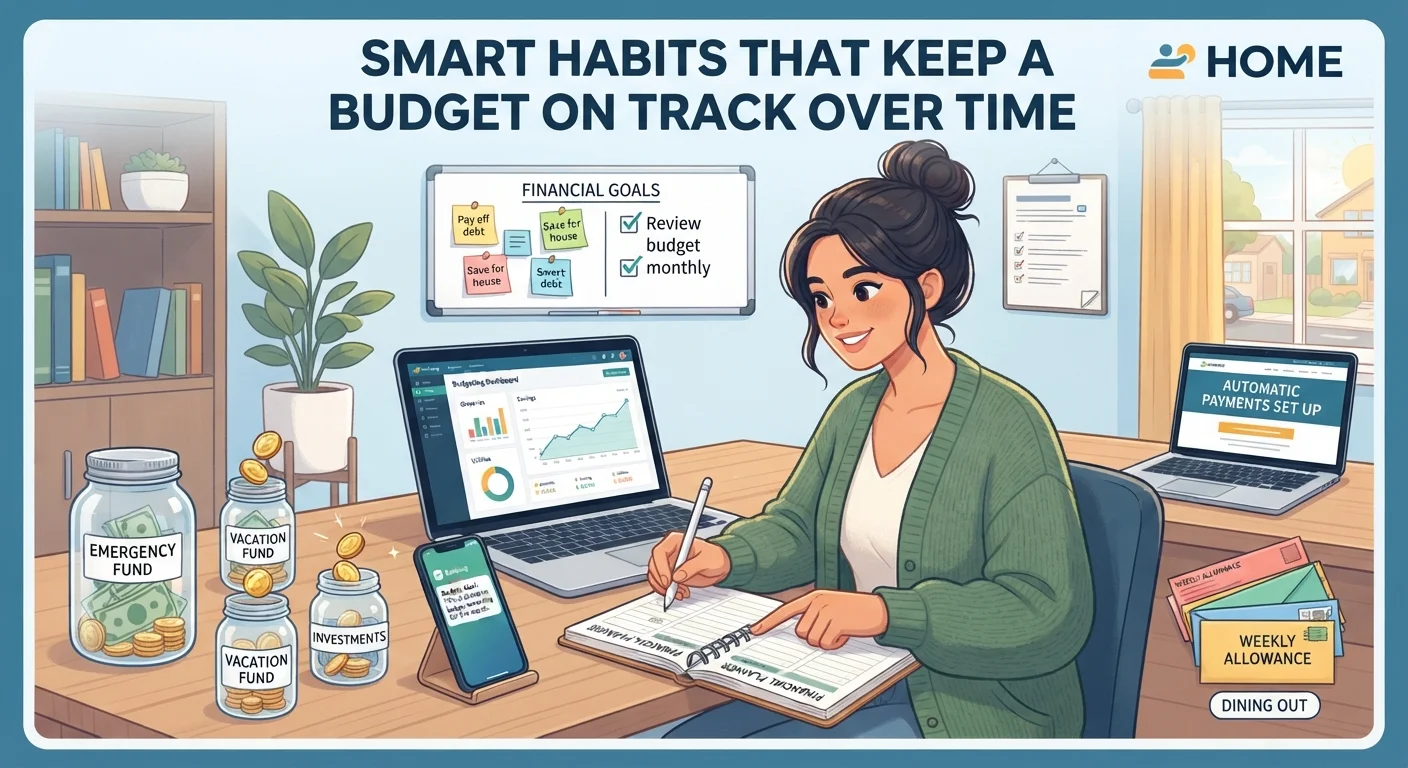
The habits that actually sustain a budget
Sustained budgeting depends on a small number of repeated actions rather than a complex system. The practices below are ones that address the most common breakdown points.
Schedule a weekly 10-minute budget check-in.
A weekly review catches overspending early, before it compounds into a month-end shortfall. It also keeps the budget a living document rather than something you set once and forget.
Automate transfers to savings on payday.
When savings move automatically before you see the money, you spend what remains rather than saving what is left over. This removes reliance on willpower for one of the most repeated financial decisions. For more on making savings work harder, see how high-yield savings accounts work.
Track small, recurring purchases separately from large fixed costs.
Coffee, subscriptions, convenience fees, and small impulse buys accumulate quickly but are easy to overlook when grouped into one broad category. Isolating them makes patterns visible. This kind of granular awareness also helps people break the paycheck-to-paycheck cycle.
Build a small buffer into every spending category.
A buffer of 5 to 10 percent above your estimated category spend absorbs minor surprises without requiring a full budget rewrite. Without one, a single unexpected cost forces trapb-offs across every other category.
Tie each spending category to a specific personal goal.
Abstract limits are harder to respect than limits attached to something you want. Connecting a restriction to a goal shifts the framing from sacrifice to progress. This also applies when planning around larger life expenses, such as home maintenance costs that often arrive without warning.
Review and renegotiate fixed expenses once a year.
Insurance premiums, subscription rates, and utility plans change over time. Checking annually ensures you are not paying a rate you accepted years ago that has since become uncompetitive.
Quick actions you can take now
Long-term habits begin with concrete first steps. These actions require 30 minutes or less and produce results you can see within a month.
If your income is fixed or limited, the same principles apply with adjusted scale. For a practical look at managing a tight budget without eliminating meaningful expenses, the guidance on traveling on a fixed income shows how structured planning extends further than most people expect.
Start with what you already have
You do not need a specific app or spreadsheet to begin budgeting. A plain notebook or a free spreadsheet template works just as well. The format matters far less than the habit of using it consistently each week.
This article is for general informational and educational purposes only and does not constitute personalized financial, tax, or legal advice. Consult a licensed financial professional for guidance specific to your situation.

Author
Finance Editorial Team
Finance Editorial Team is the collective byline for our editorial team and contributor network. Articles published under this byline or an editorial pen name are researched, written, and reviewed according to our editorial standards for clarity, consistency, and independence before publication.
View all articles →