
Retirement Savings Accounts: IRA and 401(k) Fundamentals

Photo credit: Savy Bargains
In this article
IRAs and 401(k)s are the two most common retirement savings vehicles in the U.S. This overview explains how each works in plain, accessible terms.
What these accounts are and why they exist
IRAs and 401(k)s are tax-advantaged accounts the U.S. government created to encourage people to save for retirement. Money placed inside either type of account grows without being taxed in the same way a standard brokerage account would be. The specific tax treatment depends on which account type you use and when you pay the tax.
Neither account is an investment on its own. They are containers. The investments inside them, such as mutual funds, index funds, or bonds, are what actually grow. Understanding the container rules is the first step before making any decisions about what to put inside.
This article is for general informational purposes only and is not personalized financial, tax, or investment advice. Consult a licensed financial adviser or tax professional about your own situation.
| 401(k) type | Employer-sponsored (IRS Publication 560) |
| IRA type | Individual (self-opened) (IRS Publication 590-A) |
| 401(k) contribution limit (2024) | $23,000 (under 50); $30,500 (50+) (IRS, 2024) |
| IRA contribution limit (2024) | $7,000 (under 50); $8,000 (50+) (IRS, 2024) |
| Early withdrawal penalty | 10% plus income tax (before age 59 1/2) (IRS general rule; exceptions apply) |
| Roth IRA income limits | Phase-out begins at $146,000 (single filers, 2024) (IRS, 2024) |
How a 401(k) works
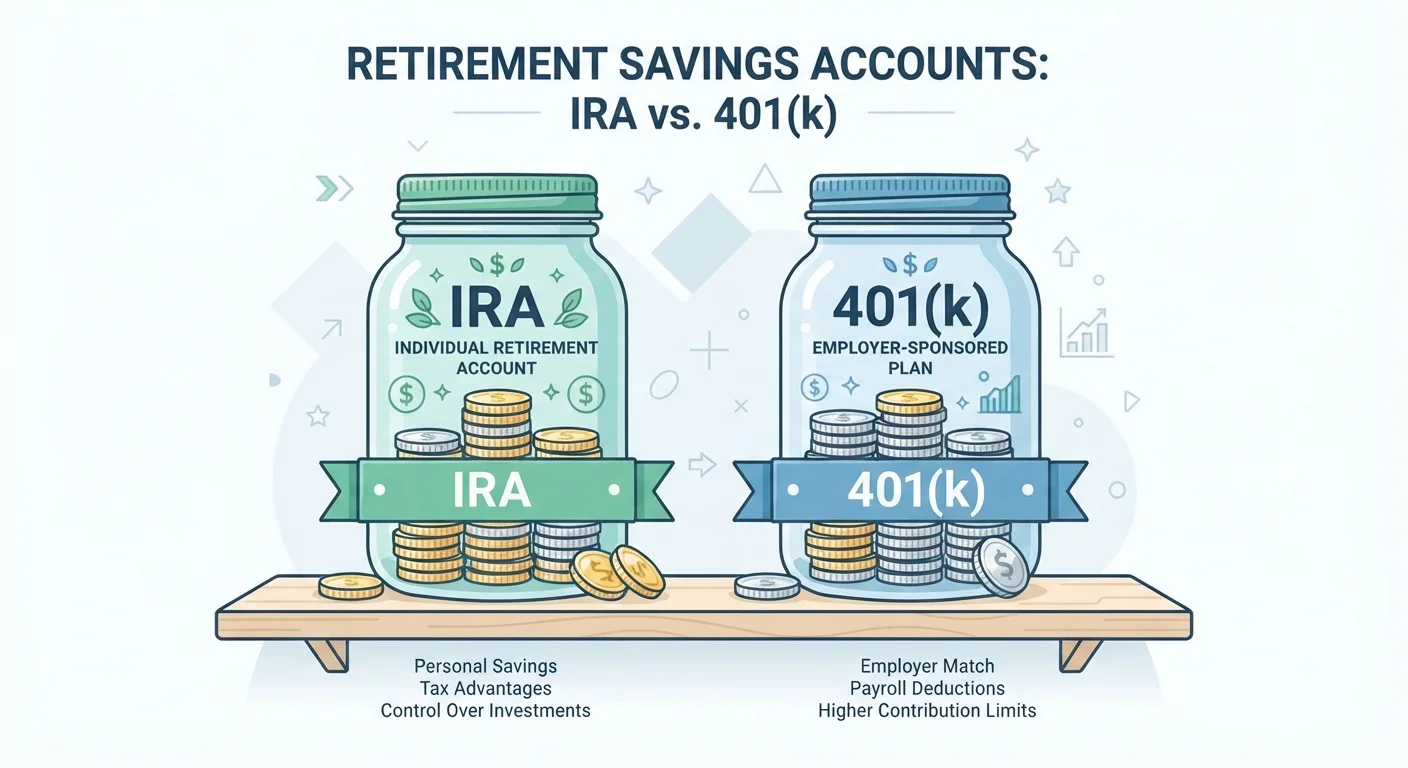
A 401(k) is offered through an employer. Contributions come out of your paycheck before income taxes are applied, which lowers your taxable income for the year you contribute. The money grows tax-deferred, meaning you pay income tax only when you withdraw funds in retirement.
Many employers match a portion of employee contributions up to a set percentage of salary. That match is additional compensation; leaving it on the table by under-contributing is a common and costly mistake. The IRS sets annual contribution limits that adjust periodically for inflation. Workers aged 50 and older can contribute extra through what the IRS calls catch-up contributions.
Withdrawals before age 59 1/2 generally trigger a 10% early withdrawal penalty on top of ordinary income tax, with limited exceptions. Required minimum distributions (RMDs) begin at a specific age set by current tax law, forcing account holders to take out a minimum amount each year.
How an IRA works
An IRA (Individual Retirement Account) is opened independently, not through an employer. Anyone with earned income below the IRS eligibility thresholds can open one. Two main varieties exist: traditional and Roth.
A traditional IRA works similarly to a 401(k) in terms of tax timing: contributions may be tax-deductible depending on your income and whether you have a workplace plan, growth is tax-deferred, and withdrawals in retirement are taxed as ordinary income. RMD rules also apply.
A Roth IRA flips the tax timing. Contributions are made with after-tax dollars, so there is no upfront deduction. In exchange, qualified withdrawals in retirement are tax-free, including the growth. Roth IRAs currently have no RMDs during the account owner's lifetime, which gives more flexibility in retirement income planning. Income limits restrict who can contribute directly to a Roth IRA.
IRA contribution limits are lower than 401(k) limits, but the same catch-up provision for those 50 and older applies. You can hold both an IRA and a 401(k) simultaneously; your ability to deduct traditional IRA contributions may be affected if you also participate in a workplace plan.
For context on other tax-advantaged saving beyond retirement, see how HSAs, FSAs, and 529s work.
Tax-deferred growth
Investment gains inside the account are not taxed each year. Tax is owed only when money is withdrawn, typically in retirement.
Roth IRA
An IRA funded with after-tax dollars. Qualified withdrawals in retirement, including earnings, are generally tax-free.
Required minimum distribution (RMD)
A minimum amount the IRS requires account holders to withdraw each year once they reach the applicable age. Rules differ by account type.
Catch-up contribution
An additional amount workers aged 50 and older are allowed to contribute to retirement accounts above the standard annual limit.
Employer match
A contribution an employer makes to an employee's 401(k), typically a percentage of what the employee contributes, up to a set limit.
Traditional IRA
An individual retirement account where contributions may be tax-deductible and withdrawals in retirement are taxed as ordinary income.
Choosing between them and what to consider
Most financial guidance suggests contributing at least enough to a 401(k) to capture any employer match before directing additional savings elsewhere. Beyond that point, the comparison between adding more to a 401(k) versus opening or maxing an IRA depends on factors including current income, expected tax rate in retirement, investment options available in the 401(k), and whether a Roth or traditional structure fits your situation.
401(k) investment menus are set by the employer and may be limited. IRAs opened at a brokerage typically offer a wider range of investment choices. If your 401(k) carries high-fee fund options, an IRA may let you access lower-cost alternatives.
Neither account replaces liquid savings for short-term needs. Retirement accounts are designed for long-term holding. For savings goals with a shorter horizon, a high-interest account may be more appropriate. High-yield savings accounts fill a different role than retirement vehicles and are worth understanding separately.
Tax law governing these accounts changes periodically. Consult a licensed tax professional or financial adviser to make sure your approach reflects current rules and your personal circumstances.

Author
Finance Editorial Team
Finance Editorial Team is the collective byline for our editorial team and contributor network. Articles published under this byline or an editorial pen name are researched, written, and reviewed according to our editorial standards for clarity, consistency, and independence before publication.
View all articles →