
Things Drivers Get Wrong About Auto Insurance
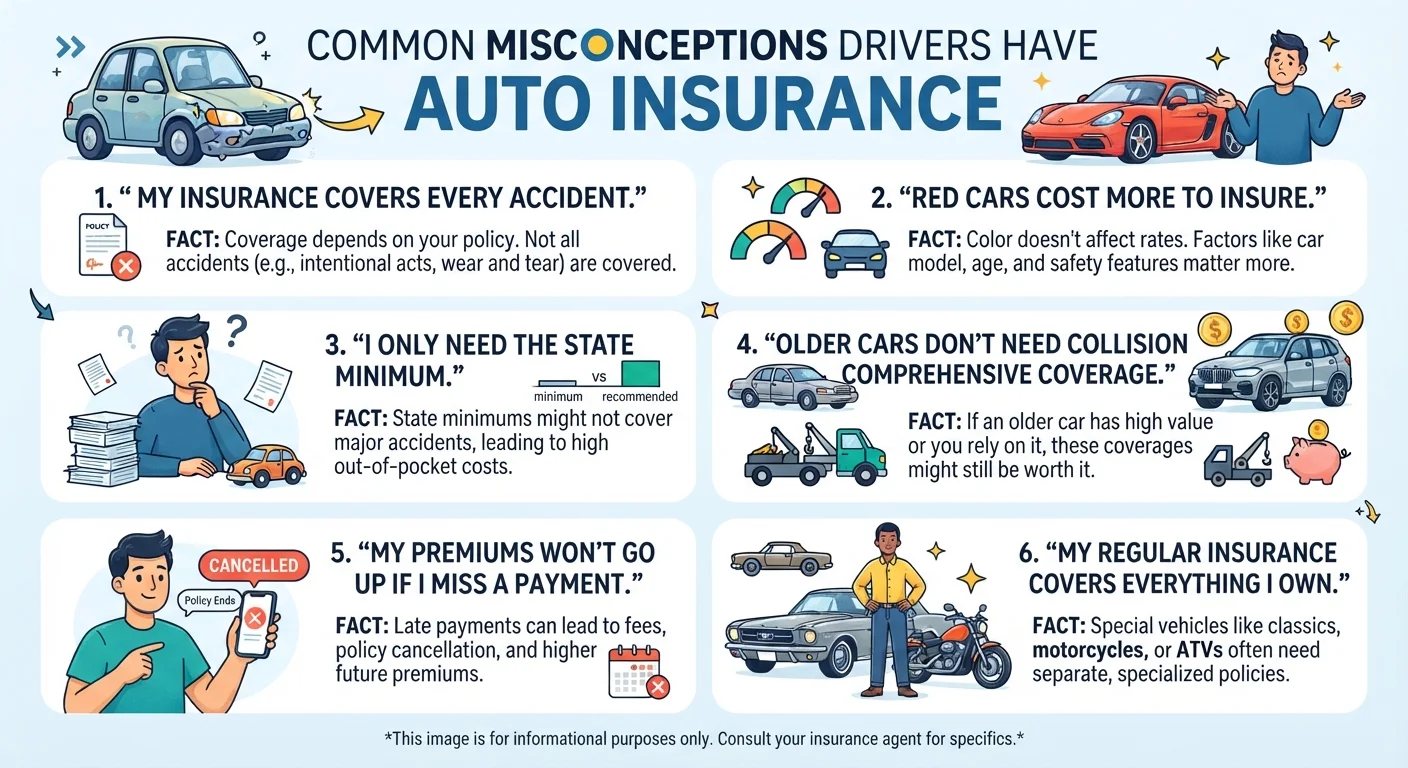
Photo credit: Savy Bargains
In this article
From color affecting premiums to full coverage meaning total protection, these widespread myths can lead to costly coverage gaps.
Key Takeaways
- Your car's color has no effect on your insurance premium.
- 'Full coverage' does not mean every possible loss is covered; gaps exist.
- Your credit history can affect your premium in most U.S. states.
- Personal auto policies typically do not cover business use of your vehicle.
- Minimum state coverage protects other drivers, not necessarily your own car or finances.
Why these myths persist
Auto insurance touches nearly every driver, yet the way policies actually work remains opaque to most people. Insurers use complex rating algorithms, policies run dozens of pages, and agents do not always walk customers through every detail. The result is a set of widely held beliefs, passed along through conversation and assumption, that can lead drivers to carry the wrong coverage or skip protections they actually need.
The myths below are among the most common. Getting these facts straight can help you ask better questions before you buy or renew a policy.
Myth
Red cars cost more to insure because insurers charge more for that color.
Fact
Insurers do not factor in vehicle color when calculating premiums.
This is one of the most durable myths in auto insurance. Insurers rate vehicles based on the make, model, trim level, age, engine size, safety record, and theft rates, not the paint. When you get a quote, you will notice that color is never a field on the application. What does matter is the specific vehicle: a sports trim of a model often costs more to insure than a base trim of the same model, regardless of color.
Myth
Having 'full coverage' means the insurer will pay for any loss involving my car.
Fact
'Full coverage' is an informal shorthand, not a defined policy term, and standard policies exclude many scenarios.
'Full coverage' typically refers to a combination of liability, collision, and comprehensive coverage, but that combination still has exclusions, deductibles, and limits. Mechanical breakdown, regular wear and tear, personal belongings left in the car, and certain natural disaster events may not be covered depending on your policy. The gaps that standard policies leave are worth reviewing carefully before you assume you are protected.
Myth
My credit score has nothing to do with my car insurance rate.
Fact
In most states, insurers use a credit-based insurance score as one factor in setting premiums.
Insurance companies in most U.S. states are permitted to use credit-based insurance scores, which are derived from credit report data, when pricing auto policies. This is separate from your credit score used for lending. Drivers with lower credit-based insurance scores often pay higher premiums. California, Hawaii, Massachusetts, and Michigan prohibit or restrict this practice, so whether it applies depends on where you live. Beyond credit, many other rating factors influence your premium beyond what most drivers expect.
Myth
My personal auto policy covers me when I drive for a rideshare or delivery service.
Fact
Standard personal auto policies generally exclude coverage during business or commercial use of the vehicle.
When you use your car to carry passengers for hire or deliver goods for pay, most personal auto policies treat that as commercial use and will not pay a claim that happens during that period. Rideshare companies typically provide some coverage, but there are gaps, particularly during the period when the app is on but no ride has been accepted. Drivers who regularly use their cars for paid work should ask their insurer about a rideshare endorsement or a commercial policy. The differences between personal and usage-based policies can help clarify which structure fits your situation.
Myth
State minimum coverage is enough to protect me financially after an accident.
Fact
State minimums protect other drivers from your liability; they often leave your own vehicle and finances exposed.
Every state requires drivers to carry at least some liability coverage, but the minimums are set to meet a legal threshold, not to cover a serious accident. If you cause a crash where injuries or property damage exceed your liability limits, you can be personally responsible for the difference. State minimums also include no collision or comprehensive coverage, so your own car would not be repaired or replaced if it is damaged. Understanding what each coverage level actually includes helps you decide whether the minimum is enough for your situation.
Myth
My rates can only go up after an at-fault accident; they never drop back down.
Fact
Rate increases from accidents and violations are typically temporary, often lasting three to five years.
Most insurers apply a surcharge after an at-fault accident or moving violation, but that surcharge does not stay permanently. Depending on the insurer and state, incidents typically affect your rate for three to five years before dropping off your rating history. How long driving record events affect your premium varies by the type of incident and where you live, but the timeline is finite.
What to check on your own policy
Most of the confusion around auto insurance comes from never reading the actual policy documents. The declarations page summarizes your coverages, limits, and deductibles in a few pages, and it is worth reviewing once a year, especially after buying a new vehicle or changing jobs.
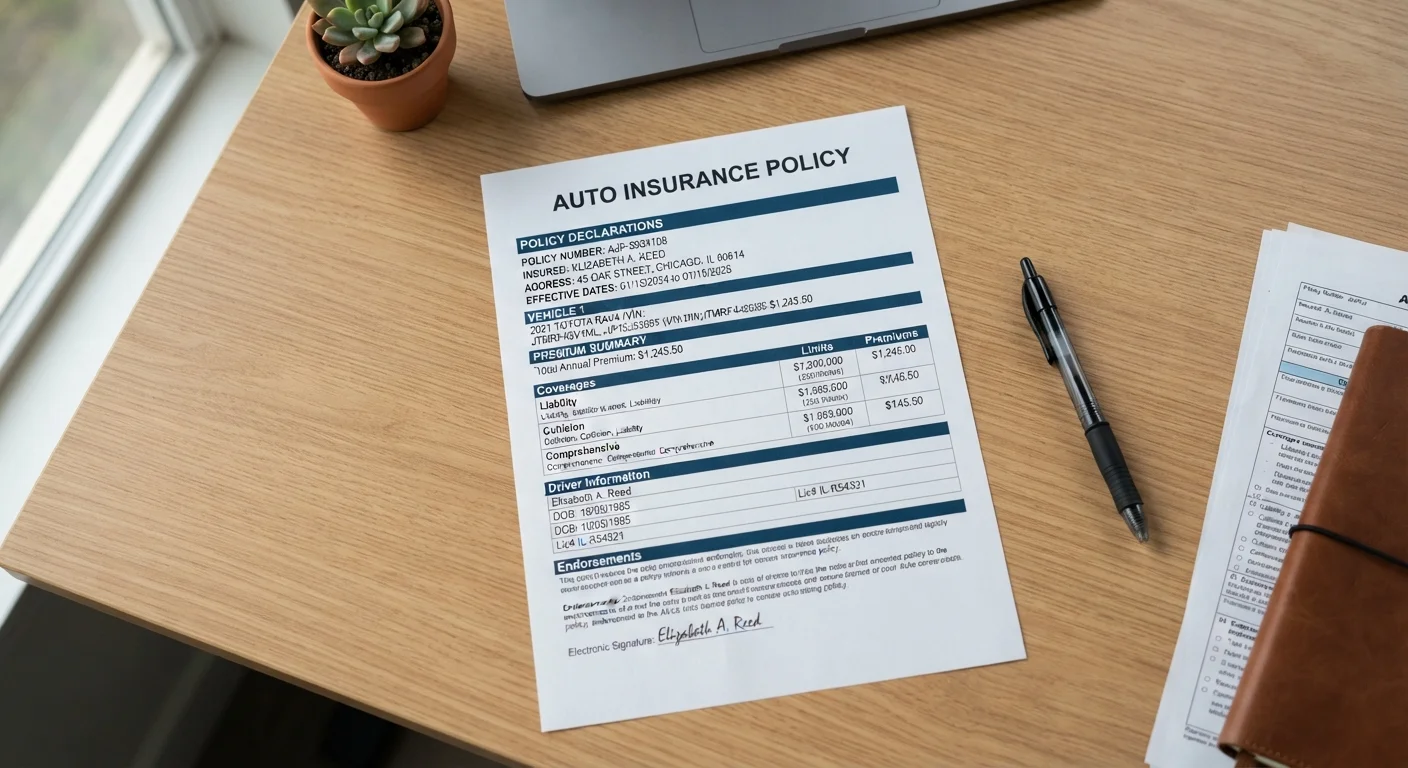
Pay attention to exclusions. Every policy has a section listing what it does not cover, and that section is where many drivers are caught off guard at claim time. If you finance or lease your vehicle, gap insurance is one protection worth understanding, since standard policies pay the actual cash value of a vehicle, which may be less than what you still owe on a loan.
Where you park your car also matters more than most drivers realize. Insurers use your ZIP code as a rating factor, accounting for local accident rates, theft rates, and weather patterns. A move across town can change your premium. If you have questions about what your policy does or does not include, a licensed insurance agent or your state's insurance department can help clarify without selling you anything.
This article is for general informational purposes only and does not constitute insurance, legal, or financial advice. Coverage terms, exclusions, and regulations vary by insurer, policy, and state. Read your policy documents and consult a licensed insurance professional for guidance specific to your situation.

Author
Auto Editorial Team
Auto Editorial Team is the collective byline for our editorial team and contributor network. Articles published under this byline or an editorial pen name are researched, written, and reviewed according to our editorial standards for clarity, consistency, and independence before publication.
View all articles →