
Making Sense of Your Explanation of Benefits

Photo credit: Savy Bargains
In this article
Your EOB is not a bill, but it contains critical information. Here is how to read each section and catch billing errors early.
Key Takeaways
- An EOB is not a bill; it is your insurer's record of how a claim was processed.
- Every EOB shows the billed amount, the insurer's allowed amount, and your share of the cost.
- Comparing your EOB to the provider's bill is the most reliable way to catch billing errors.
- Errors on EOBs are common and worth disputing through your insurer's formal process.
- If a claim is denied, the EOB states the reason and your right to appeal.
What an EOB actually is
An Explanation of Benefits (EOB) is a summary your health insurance company sends after a provider submits a claim on your behalf. It is not a bill. It is a record of how your insurer processed that claim and what portion, if any, you may owe.
Insurers are generally required to send an EOB after any covered service, whether you receive care from a primary care doctor, a specialist, a hospital, or a lab. Medicare Advantage and employer-sponsored plans each have slightly different formats, but every EOB covers the same core information. If you are still sorting out which plan type generated the EOB you are reading, the overview of health insurance plan types explains how HMOs, PPOs, and HDHPs each affect your cost share.
Some insurers deliver EOBs by mail; others post them to an online member portal. Either way, keep each one until you have paid any related provider bill and confirmed the amounts match.
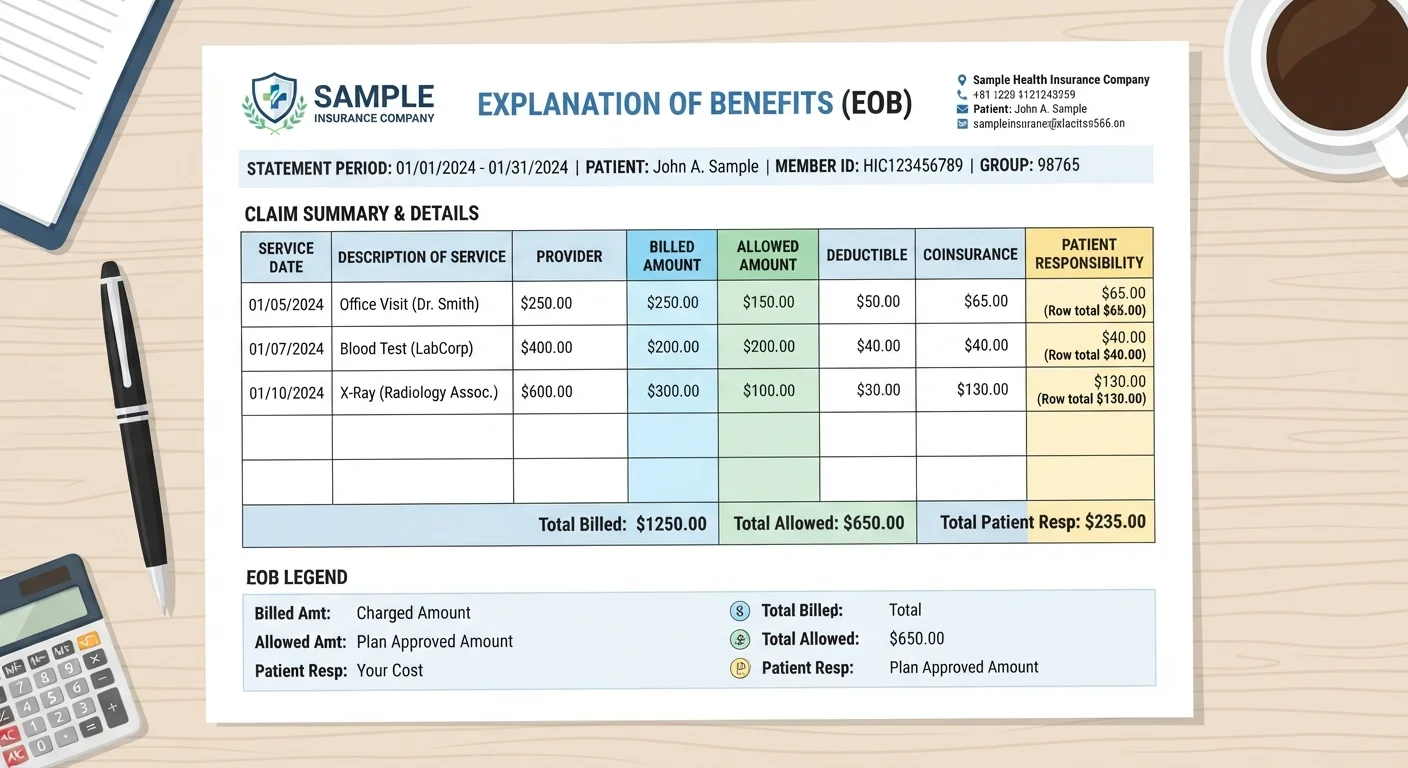
The standard sections of an EOB
Most EOBs are organized into a header, a claim detail table, and a summary section. Understanding each part makes the document much less intimidating.
Header information
The top of the form identifies the insured member, the plan name, the claim number, and the date the claim was processed. Confirm the member name and ID number match your insurance card before reading further. A mismatch can indicate a filing error.
Provider and service details
This section lists the provider who submitted the claim, the date of service, and a procedure code with a brief description. Procedure codes follow a standardized system (called CPT codes) that insurers and providers both use. If a code description does not match the service you received, that discrepancy is worth investigating.
The cost columns
This is the section most people find confusing. A typical EOB shows four figures side by side:
- Billed amount: what the provider charged before any adjustments.
- Allowed amount: the negotiated rate your insurer has agreed to pay for that service. This is almost always lower than the billed amount.
- Plan paid: the portion your insurer covers after applying your deductible, copay, or coinsurance rules.
- Your responsibility: the amount you may owe the provider directly.
If you have a high-deductible health plan, the "your responsibility" column will often show the full allowed amount until your deductible is met. The guide to HDHPs explains how deductible mechanics affect these figures.
Check your deductible and out-of-pocket totals
Many EOBs include a running year-to-date summary showing how much of your deductible and out-of-pocket maximum you have used. Reviewing this section with each new EOB helps you anticipate future costs and avoid surprises when scheduling additional care.
Denial and remark codes
When a claim is partially or fully denied, the EOB prints a remark or reason code with a plain-language explanation. Common reasons include services requiring prior authorization, out-of-network providers, or duplicate claims. The EOB must also state your right to appeal and the deadline for doing so. If you believe a denial is incorrect, that appeal process is your formal recourse. Medicare beneficiaries have a specific multi-step appeals process covered in the Medicare appeals guide.
How to check your EOB for errors
Billing errors in health care are not rare. Common problems include duplicate charges for the same service, a procedure coded incorrectly, and charges for services you did not receive.
Gather your documents
Collect the EOB, any itemized bill from the provider, and your insurance card. The itemized bill lists every individual charge. A summary bill does not have enough detail for a comparison.
Match the basic identifiers
Confirm that the member name, insurance ID, date of service, and provider name on the EOB match what appears on the provider's bill. Any mismatch can signal a misfiled claim.
Compare procedure codes and descriptions
Find each CPT code on the EOB and locate the matching line on the itemized provider bill. The description should correspond to what actually happened during your visit. A code for a complex office visit billed when you had a routine checkup is worth questioning.
Check the cost columns against your plan terms
Review the "your responsibility" amount against your plan's copay, coinsurance, and deductible schedule. If you have a PPO or HMO, the cost-sharing rules differ significantly. The HMO vs. PPO comparison outlines how network status affects what you owe. Confirm the provider was treated as in-network if you used an in-network facility.
Act on discrepancies before paying
If you find a mismatch between the EOB and the provider bill, or if a charge looks incorrect, contact the provider's billing office first. Many errors are resolved at that level. If the issue involves how the insurer processed the claim, call the member services number on your insurance card and ask for a formal claim review.
This article is for general informational purposes only and does not constitute medical or financial advice. Coverage terms, cost-sharing rules, and appeal rights vary by plan and provider. Review your plan documents and contact your insurer or a licensed insurance professional for guidance specific to your situation.

Author
Health Editorial Team
Health Editorial Team is the collective byline for our editorial team and contributor network. Articles published under this byline or an editorial pen name are researched, written, and reviewed according to our editorial standards for clarity, consistency, and independence before publication.
View all articles →