
Why People End Up Underinsured and How to Spot the Warning Signs

Photo credit: Savy Bargains
In this article
Being underinsured is more common than people realize. Learn the gaps that lead to unexpected bills and how to evaluate your actual coverage.
Key Takeaways
- Being underinsured means your plan exists but does not adequately cover your actual medical costs.
- High deductibles and narrow networks are two of the most common sources of unexpected out-of-pocket expenses.
- Many people discover coverage gaps only after receiving a large medical bill.
- Reviewing your Summary of Benefits and Coverage document each year can help catch mismatches early.
- Seniors on Medicare should check whether their plan covers the services they use most frequently.
What being underinsured actually means
Underinsured does not mean uninsured. It means a person has a health plan but the plan's cost-sharing requirements, coverage limits, or network restrictions leave them exposed to medical bills they cannot reasonably absorb. The Commonwealth Fund defines underinsured adults as those whose out-of-pocket costs or deductibles represent a high share of their income, and its surveys have consistently found that roughly one in four insured Americans fall into this category.
The gap between having coverage and having adequate coverage is where most financial harm happens. People skip care, delay treatment, or face debt not because they lacked insurance but because their plan did not cover enough of the bill. Understanding where those gaps come from is the first step toward avoiding them.
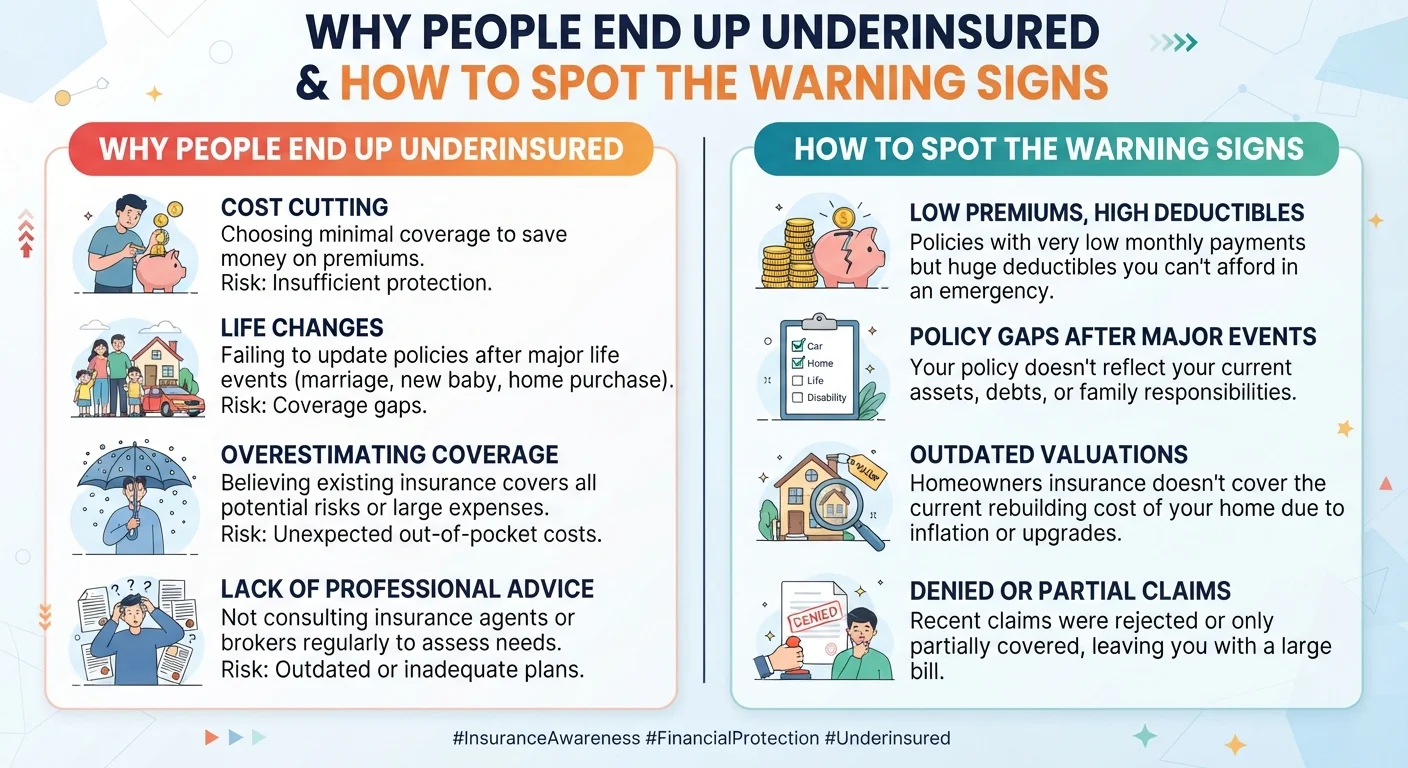
Coverage gaps in health insurance share some structural similarities with gaps in other types of insurance. If you want to understand how this problem appears in a different context, the article on common home insurance misconceptions shows how the same pattern of assuming more coverage than exists plays out for homeowners.
Common mistakes that lead to being underinsured
Assuming any active health plan equals adequate coverage.
Why it happens: Having insurance feels like a finish line. Once enrolled, many people stop evaluating whether the plan actually fits their medical needs and financial situation.
Ignoring the out-of-pocket maximum until a large bill arrives.
Why it happens: The out-of-pocket maximum sounds like a safety net, but people often do not realize it only applies to in-network, covered services. Costs from out-of-network providers may not count toward it.
Choosing a plan based on premium alone without checking the provider network.
Why it happens: Lower-premium plans are appealing, especially when budgets are tight. Narrow-network plans can have significantly lower premiums but restrict which doctors and hospitals count as in-network.
Overlooking what a plan does not cover, including common services.
Why it happens: Benefit summaries are written in dense language, and most people read the highlights rather than the exclusions section.
Not updating coverage after a major life or health change.
Why it happens: People often pick a plan once and let it auto-renew without considering whether their health needs have shifted, whether they have a new diagnosis, added a dependent, or changed income.
1 in 4
Insured adults who are underinsured
The Commonwealth Fund has consistently found that roughly one in four insured adults in the U.S. qualify as underinsured based on out-of-pocket costs relative to income.
43%
Underinsured adults who skipped needed care due to cost
According to Commonwealth Fund survey data, a large share of underinsured adults reported going without a recommended test, treatment, or specialist visit because of cost.
Warning signs to watch for in your current plan
Several signals suggest a plan may not be providing the protection it appears to offer. If you have an annual deductible above $1,500 for an individual (or $3,000 for a family) and limited savings to cover it, that is a concrete gap between your coverage and your financial exposure. A deductible is the amount you pay before insurance starts covering most services.
Another warning sign is a mismatch between the services you use and what your plan covers. If you see a specialist regularly and your plan requires a referral or charges a high specialist copay, those costs add up quickly. Similarly, if you take maintenance medications and your plan's formulary (the list of covered drugs) places them in a high cost tier, your monthly drug costs may be far above what you expected.
Seniors: Medicare gaps can be costly
Original Medicare (Parts A and B) does not cap your out-of-pocket spending on its own. Without a Medigap or Medicare Advantage plan, a prolonged hospital stay or complex procedure can generate substantial uncovered costs. Seniors should review their coverage options during the Annual Enrollment Period each year. Consult a licensed insurance agent or your State Health Insurance Assistance Program (SHIP) counselor for guidance specific to your situation.
People managing chronic conditions, recovering from surgery, or entering a new life stage, including retirement, should be especially careful about coverage continuity. The article on insurance coverage lapses explains how even brief gaps in any type of coverage can have lasting financial effects.
If your plan has a narrow network, verify it annually. Providers leave networks without notice, and a physician who was covered when you enrolled may no longer be covered at renewal.
This article is general information, not advice
The content here describes health insurance concepts for educational purposes only. It is not personalized financial, insurance, or medical advice. Coverage terms vary by insurer, plan, and state. Read your actual policy documents and consult a licensed insurance professional or a qualified healthcare provider before making decisions about your coverage.
This article is for general informational purposes only and does not constitute medical, insurance, or financial advice. Consult a licensed insurance professional or qualified healthcare provider for guidance specific to your situation.

Author
Health Editorial Team
Health Editorial Team is the collective byline for our editorial team and contributor network. Articles published under this byline or an editorial pen name are researched, written, and reviewed according to our editorial standards for clarity, consistency, and independence before publication.
View all articles →